
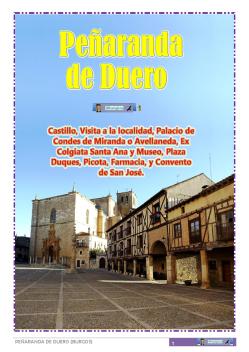
 Dedicar un día a la visita de esta villa medieval que conserva su núcleo con las construcciones típicas castellanas. La localidad ha sido reconocida como “Pueblo Mágico de España”
Encontraras las siguientes visitas:
- El Castillo de los S. XII y XV con una forma alargada asentado sobre el cerro que domina la población.
- Visita de la localidad, con las murallas, la Farmacia del S. XVIII, sus típicas construcciones, etc. de esta villa medieval.
- El palacio de Condes de Miranda o de Avellaneda.- Construido en el siglo XVI por encargo de don Francisco de Zúñiga Avellaneda y Velasco, tercer conde de Miranda del Castañar.
- Ex Colegiata de Santa Ana – Museo.- Construida a mediados del siglo XVI (1540), con trazas de Gil de Hontañón, con una portada barroca. Dispone de un interesante Museo.
- En la Plaza Duques, se encuentra el Rollo o picota del S. XVI, es una columna muy labrada de estilo gótico, donde se ejecutaban los reos de la justicia y se exponían a la vergüenza pública.
- Y en los arrabales de la población se encuentra su convento de San José que fue fundado en el S. XVI por Duque de Peñaranda.
Puedes descargarte el PDF con información, planos, fotos y contactos.
Pulsar sobre la imagen con el botón derecho y guardar como…para descargar y llevar el archivo PDF en tu tablet o smartphone. Y si deseas conocer las nuevas publicaciones solo tienes incluirte en seguir.
-
PEÑARANDA (BURGOS)
Another of the important castles in the province of Burgos, to stop the advance of the Arabs and later the reconquest.
It is located in this town recognized as «Magic Town of Spain»
You will find the following visits:
- The Castle from the 12th and 15th centuries with an elongated shape set on the hill that dominates the town.
- Visit of the town, with the walls, the Pharmacy of the 18th century, its typical constructions, etc. of this medieval town.
- The Palace of the Counts of Miranda or Avellaneda.- Built in the 16th century on behalf of Don Francisco de Zúñiga Avellaneda y Velasco, third count of Miranda del Castañar.
- Former Collegiate Church of Santa Ana – Museum.- Built in the mid-16th century (1540), with traces by Gil de Hontañón, with a baroque portal. It has an interesting museum.
- In the Square Duques, there is the Rollo or pillory from the 16th century, it is a very carved column in the Gothic style, where the criminals of justice were executed and exposed to public shame.
- And on the outskirts of the town is the convent of San José, which was founded in the 16th century by the Duke of Peñaranda.
You can download the PDF with information, plans, photos and contacts.
Click on the image with the right button and save as… to download and take the PDF file on your tablet or smartphone. And if you want to know the new publications you just have to include yourself in following.
-
PEÑARANDA (BURGOS)
Another of the important castles in the province of Burgos, to stop the advance of the Arabs and later the reconquest.
It is located in this town recognized as «Magic Town of Spain»
You will find the following visits:
- The Castle from the 12th and 15th centuries with an elongated shape set on the hill that dominates the town.
- Visit of the town, with the walls, the Pharmacy of the 18th century, its typical constructions, etc. of this medieval town.
- The Palace of the Counts of Miranda or Avellaneda.- Built in the 16th century on behalf of Don Francisco de Zúñiga Avellaneda y Velasco, third count of Miranda del Castañar.
- Former Collegiate Church of Santa Ana – Museum.- Built in the mid-16th century (1540), with traces by Gil de Hontañón, with a baroque portal. It has an interesting museum.
- In the Carré Duques, there is the Rollo or pillory from the 16th century, it is a very carved column in the Gothic style, where the criminals of justice were executed and exposed to public shame.
- And on the outskirts of the town is the convent of San José, which was founded in the 16th century by the Duke of Peñaranda.
You can download the PDF with information, plans, photos and contacts.
Click on the image with the right button and save as… to download and take the PDF file on your tablet or smartphone. And if you want to know the new publications you just have to include yourself in following.
-
PEÑARANDA (BURGOS)
Un autre des châteaux importants de la province de Burgos, pour arrêter l’avancée des Arabes et plus tard la reconquête.
Il est situé dans cette ville reconnue comme «Magic Town of Spain»
Vous trouverez les visites suivantes :
- Le Château des XIIe et XVe siècles de forme allongée posé sur la colline qui domine la ville.
- Visite de la ville, avec les remparts, la Pharmacie du 18ème siècle, ses constructions typiques, etc. de cette ville médiévale.
- Le Palais des Comtes de Miranda ou Avellaneda.- Construit au XVIe siècle au nom de Don Francisco de Zúñiga Avellaneda y Velasco, troisième comte de Miranda del Castañar.
- Ancienne Collégiale de Santa Ana – Musée.- Construite au milieu du XVIe siècle (1540), avec des traces de Gil de Hontañón, avec un portail baroque. Il a un musée intéressant.
- Sur la Quadrat Duques, il y a le Rollo ou pilori du XVIe siècle, c’est une colonne très sculptée dans le style gothique, où les criminels de justice étaient exécutés et exposés à la honte publique.
- Et à la périphérie de la ville se trouve le couvent de San José, fondé au XVIe siècle par le duc de Peñaranda.
Vous pouvez télécharger le PDF avec informations, plans, photos et contacts.
Cliquez sur l’image avec le bouton droit et enregistrer sous… pour télécharger et emporter le fichier PDF sur votre tablette ou votre smartphone. Et si vous voulez connaître les nouvelles publications, il vous suffit de vous inclure dans la suite.
-
PEÑARANDA (BURGOS)
Eine weitere wichtige Burg in der Provinz Burgos, um den Vormarsch der Araber und später die Rückeroberung zu stoppen.
Es befindet sich in dieser Stadt, die als «magische Stadt Spaniens» bekannt ist.
Sie finden die folgenden Besuche:
- Die Burg aus dem 12. und 15. Jahrhundert mit länglicher Form auf dem Hügel, der die Stadt beherrscht.
- Besichtigung der Stadt mit den Mauern, der Apotheke aus dem 18. Jahrhundert, ihren typischen Bauten usw. dieser mittelalterlichen Stadt.
- Der Palast der Grafen von Miranda oder Avellaneda.- Erbaut im 16. Jahrhundert im Auftrag von Don Francisco de Zúñiga Avellaneda y Velasco, dritter Graf von Miranda del Castañar.
- Ehemalige Stiftskirche Santa Ana – Museum.- Erbaut Mitte des 16. Jahrhunderts (1540), mit Spuren von Gil de Hontañón, mit barockem Portal. Es hat ein interessantes Museum.
- Auf der Quadrat Duques befindet sich der Rollo oder Pranger aus dem 16. Jahrhundert, eine sehr geschnitzte Säule im gotischen Stil, an der die Verbrecher der Justiz hingerichtet und der öffentlichen Schande ausgesetzt wurden.
- Am Stadtrand liegt das Kloster San José, das im 16. Jahrhundert vom Herzog von Peñaranda gegründet wurde.
Sie können das PDF mit Informationen, Plänen, Fotos und Kontakten herunterladen.
Klicken Sie mit der rechten Maustaste auf das Bild und speichern unter…, um die PDF-Datei herunterzuladen und auf Ihrem Tablet oder Smartphone zu übernehmen. Und wenn Sie die Neuerscheinungen wissen wollen, müssen Sie sich nur im Folgenden eintragen.
 Salidas