
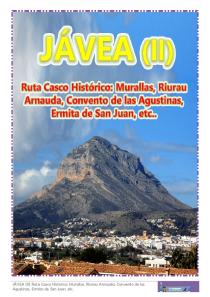
 Esta es la segunda parte como continuación a la visita del casco antiguo y otros lugares próximos al mismo efectuando todo el recorrido de forma peatonal
Encontraras las siguientes visitas:
- Recorridos casco histórico.- Las casas (góticas de los S.XV al XVII) tienen un pequeño recorrido comenzando en la calle Sor María Gallart (Junto a la Iglesia de San Bartolomé) Plaza de la Iglesia con un claro ejemplo del gótico civil es el Palacio de los Sapena (S.XV), con arcos carpaneles en la galería y ventanas geminadas y trilobuladas. ) Y la Casa de los Bolufer (S.XVIII –XIX) En su fachada, resaltan sus remates en tosca y las rejas y balcones, realizados en forja y la madera de mobiliario que fue importada para su construcción. Calle Santa Marta, Sor Catalina Bas, San Pedro Martir, Metge González, Mayor, y Estret.
- Convento de las Agustinas.- Sobre este amplio solar, se construyó en el año 1946 el actual convento destinado a acoger la comunidad de las Agustinas Descalzas de clausura, abandonándolo definitivamente en 2003. cuya iglesia está dedicada a San Felipe Neri y Santa Mónica.
- Ermita de San Juan.- Este templo pertenece al grupo cuando se construyeron las ermitas de conquista del S. XV-XVI tardo-gótica, construida a extramuros. En su interior salieron 30 sepulturascon tumbas antropomorfas excavadas en su suelo.
- Cementerio Viejo.- Cementerio inaugurado a principios del S. XIX, el primer enterramiento se efectuó en 1817, y la ermita se convirtió en capilla funeraria.
- Murallas.- Estas murallas fueron demolidas en 1873 quedando mínimas muestras. Las que ahora vemos son una reproducción de los basamentos de ellas en esta parte de la villa.
- Y el Riurau de Arnauda.- Este era uno de los secaderos de Pasas. A lo largo del S. XVIII y hasta mediados del S. XIX se convierte Jávea (y en otras poblaciones de la Marina Alta) en el centro productor y exportador a los mercados nor-europeos y americanos
Puedes descargarte el PDF con información, planos, fotos y contactos.
Pulsar sobre la imagen con el botón derecho y guardar como…para descargar y llevar el archivo PDF en tu tablet o Smartphone toda la información. Y si deseas conocer las nuevas publicaciones solo tienes incluirte en seguir para recibirlas por correo electrónico.
-
JÁVEA (II) Historical Center Route: Walls, Riurau Arnauda, Las Agustinas Convent, San Juan Hermitage, etc.
This is the second part as a continuation of the visit to the old town and other places close to it, making the entire route pedestrian.
You will find the following visits:
- Tours of the historic center.- The houses (Gothic from the 15th to the 17th centuries) have a small tour starting on Calle Sor María Gallart (Next to the Church of San Bartolomé) Plaza de la Iglesia with a clear example of civil Gothic is the Palace of the Sapena (S.XV), with carpanel arches in the gallery and mullioned and trefoil windows. ) And the House of the Bolufer (S.XVIII -XIX) On its façade, its rough finish and the bars and balconies stand out, made of wrought iron and the furniture wood that was imported for its construction. Santa Marta Street, Sor Catalina Bas, San Pedro Martir, Metge González, Mayor, and Estret.
- Convent of the Agustinas.- On this large site, the current convent was built in 1946 to house the community of the cloistered Agustinas Descalzas, abandoning it permanently in 2003. whose church is dedicated to San Felipe Neri and Santa Mónica.
- Hermitage of San Juan.- This temple belongs to the group when the conquest hermitages of the late-Gothic XV-XVI century were built, built outside the walls. Inside, there were 30 graves with anthropomorphic tombs dug into the ground.
- Old Cemetery.- Cemetery inaugurated at the beginning of the 19th century, the first burial took place in 1817, and the hermitage became a funerary chapel.
- Walls.- These walls were demolished in 1873, leaving minimal samples. The ones we see now are a reproduction of their foundations in this part of the town.
- And the Riurau de Arnauda.- This was one of the raisin dryers. Throughout the 18th century and until the middle of the 19th century, Jávea (and other towns in the Marina Alta) became the center of production and export to the North European and American markets.
You can download the PDF with information, plans, photos and contacts.
Click on the image with the right button and save as… to download and take the PDF file on your tablet or Smartphone with all the information. And if you want to know the new publications you only have to include yourself in follow to receive them by email.
-
JÁVEA (II) Route du centre historique, murailles, Riurau Arnauda, couvent de Las Agustinas, ermitage de San Juan, etc.
Il s’agit de la deuxième partie dans le prolongement de la visite de la vieille ville et d’autres lieux proches, rendant tout le parcours piéton.
Vous trouverez les visites suivantes :
- Visites du centre historique.- Les maisons (gothiques du XVe au XVIIe siècles) ont un petit tour à partir de la Calle Sor María Gallart (à côté de l’église de San Bartolomé) Plaza de la Iglesia avec un exemple clair de gothique civil est le Palais de la Sapena (S.XV), avec des arcs en carpane dans la galerie et des fenêtres à meneaux et trilobées. ) Et la Maison du Bolufer (S.XVIII -XIX) Sur sa façade, sa finition brute et les barreaux et balcons se distinguent, en fer forgé et le bois de meubles qui a été importé pour sa construction. Rue Santa Marta, Sor Catalina Bas, San Pedro Martir, Metge González, maire et Estret.
- Couvent des Agustinas.- Sur ce vaste site, le couvent actuel a été construit en 1946 pour abriter la communauté des Agustinas Descalzas cloîtrés, l’abandonnant définitivement en 2003. dont l’église est dédiée à San Felipe Neri et Santa Mónica.
- Ermitage de San Juan.- Ce temple appartient au groupe des ermitages de la conquête du XVe-XVIe siècle gothique tardif, construits à l’extérieur des murs. À l’intérieur, il y avait 30 tombes avec des tombes anthropomorphes creusées dans le sol.
- Ancien Cimetière.- Cimetière inauguré au début du XIXème siècle, la première inhumation eut lieu en 1817, et l’ermitage devint une chapelle funéraire.
- Murs.- Ces murs ont été démolis en 1873, laissant des échantillons minimes. Celles que nous voyons maintenant sont une reproduction de leurs fondations dans cette partie de la ville.
- Et le Riurau de Arnauda.- C’était l’un des séchoirs à raisins secs. Tout au long du XVIIIe siècle et jusqu’au milieu du XIXe siècle, Jávea (et d’autres villes de la Marina Alta) est devenue le centre de production et d’exportation vers les marchés nord-européen et américain.
Vous pouvez télécharger le PDF avec informations, plans, photos et contacts.
Cliquez sur l’image avec le bouton droit et enregistrer sous… pour télécharger et emporter le fichier PDF sur votre tablette ou Smartphone avec toutes les informations. Et si vous voulez connaître les nouvelles publications, vous n’avez qu’à vous inclure dans le suivi pour les recevoir par e-mail.
-
JÁVEA (II) Route durch das historische Zentrum, Mauern, Riurau Arnauda, Kloster Las Agustinas, Einsiedelei San Juan usw.
Dies ist der zweite Teil als Fortsetzung des Besuchs der Altstadt und anderer Orte in der Nähe, wodurch die gesamte Route zu Fuß geht.
Sie finden die folgenden Besuche:
- Führungen durch das historische Zentrum.- Die Häuser (gotisch aus dem 15. bis 17. Jahrhundert) haben einen kleinen Rundgang, der an der Calle Sor María Gallart (neben der Kirche San Bartolomé) und der Plaza de la Iglesia mit einem deutlichen Beispiel ziviler Gotik beginnt ist der Palast der Sapena (S.XV) mit Carpanel-Bögen in der Galerie und Pfosten- und Kleeblattfenstern. ) Und das Haus des Bolufers (S.XVIII -XIX) An seiner Fassade fallen die raue Oberfläche und die Gitterstäbe und Balkone auf, die aus Schmiedeeisen und dem für seinen Bau importierten Möbelholz bestehen. Santa Marta Street, Sor Catalina Bas, San Pedro Martir, Metge González, Bürgermeister, und Estret.
- Kloster der Agustinas.- Auf diesem großen Gelände wurde 1946 das heutige Kloster errichtet, um die Gemeinschaft der Klosterschwester Agustinas Descalzas zu beherbergen, die 2003 endgültig aufgegeben wurde. Deren Kirche ist San Felipe Neri und Santa Mónica geweiht.
- Einsiedelei von San Juan.- Dieser Tempel gehört zu der Gruppe, als die Eroberungseinsiedeleien des spätgotischen XV-XVI Jahrhunderts außerhalb der Mauern errichtet wurden. Im Inneren befanden sich 30 Gräber mit anthropomorphen Gräbern, die in den Boden gegraben wurden.
- Alter Friedhof.- Zu Beginn des 19. Jahrhunderts eingeweihter Friedhof, die erste Beerdigung fand 1817 statt, und die Einsiedelei wurde zu einer Grabkapelle.
- Mauern.- Diese Mauern wurden 1873 abgerissen und hinterließen minimale Proben. Die, die wir jetzt sehen, sind eine Reproduktion ihrer Fundamente in diesem Teil der Stadt.
- Und der Riurau de Arnauda.- Dies war einer der Rosinentrockner. Während des gesamten 18. Jahrhunderts und bis Mitte des 19. Jahrhunderts wurde Jávea (und andere Städte in der Marina Alta) zum Zentrum der Produktion und des Exports auf den nordeuropäischen und amerikanischen Markt.
Sie können das PDF mit Informationen, Plänen, Fotos und Kontakten herunterladen.
Klicken Sie mit der rechten Maustaste auf das Bild und speichern unter…, um die PDF-Datei mit allen Informationen herunterzuladen und auf Ihr Tablet oder Smartphone zu übernehmen. Und wenn Sie die Neuerscheinungen wissen wollen, müssen Sie sich nur selbst eintragen, um sie per E-Mail zu erhalten.
 Salidas