
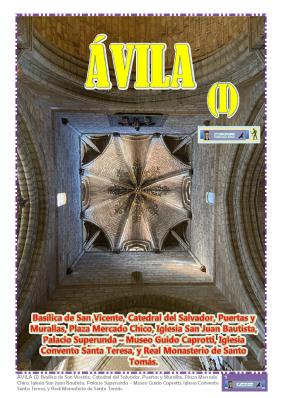
 Ruta a recorrer durante una jornada en Ávila dentro de sus murallas. Esta ciudad que cuenta con una importante muestra de arquitectura, civil y religiosa unida a la del uso militar de sus murallas.
Encontraras las siguientes visitas:
- Basílica de San Vicente.- Su construcción se inicia en torno al 1120 y se concluye en el S. XV. Es el templo destacable del románico abulense compuesto por planta es de cruz latina de seis tramos con tres naves y los brazos de crucero.
- Catedral del Salvador.- Su construcción se inició en el S. XII (entre 1160 y 1180) en estilo románico tardío y ojival, para quedar terminada en el S. XVI con estilo gótico, en su construcción inicial se realizo con “piedra sangrante” por sus vetas sangrantes o piedra caleña y la construcción gótica con granito.
- Plaza del Mercado Chico.- Esta amplia plaza de forma rectangular está dotada de soportales en tres de sus lados, en ellos tiene las instalaciones el Ayuntamiento y en otro la iglesia de San Juan Bautista.
- Iglesia de San Juan Bautista.- Templo de origen románico edificado entre el S. XI y XII, que tuvo una importante transformación en estilo gótico con influencia renacentistas a principios del S. XVI.
- Palacio Superunda-Museo Guido Caprotti.- Estamos ante un palacio renacentista que fue construido en 1580 por el regidor Pedro Ochoa Aguirre. Y posteriormente adquirido por el pintor italiano Guido Caprotti en 1916.
- Iglesia-Convento de Santa Teresa.- El edificio está construido sobre la casa natal de Santa Teresa de Jesús (de Cepeda y Ahumada), a principios del S. XVII por la Orden de los carmelitas por el maestro constructor Fray Alonso de San José de la orden y se finalizó en 1636.
- Puertas y Murallas.- Las murallas fueron construidas en la segunda mitad del S. XII tienen 2,5 km de perímetro, 87 torreones, 9 puertas, 2 postigos, es una de las mejores conservadas de España.
- Palacios.- A lo largo del recorrido veremos diversos palacios, que a su vez tenían un concepto defensivo en el interior de sus murallas.
- Y el Real Monasterio de Santo Tomás.- Construcción de este monasterio es de finales del S. XV (1480) al fundarlo Hernán Núñez de Arnate que era tesorero de los Reyes Católicos al otorgar a su esposa María Dávila junto a fray Tomás de Torquemada que actuasen en su nombre. Es un monasterio con tres claustros que lo hacen único. La iglesia destinada a albergar el mausoleo del único hijo varón de los Reyes Católicos. El claustro de los Reyes, llamado así porque parte de sus espacios fue destinado a residencia de verano para los Reyes Católicos.
Puedes descargarte el PDF con información, planos, fotos y contactos.
Pulsar sobre la imagen con el botón derecho y guardar como…para descargar y llevar el archivo PDF en tu tablet o smartphone. Y si deseas conocer las nuevas publicaciones solo tienes incluirte en seguir.
-
ÁVILA (I) Basilica of San Vicente, Cathedral of El Salvador, Doors and Walls, Plaza Mercado Chico, Church of San Juan Bautista, Superunda Palace – Guido Caprotti Museum, Church of the Convent of Santa Teresa, and Royal Monastery of Santo Tomás.
Route to travel during a day in Ávila within its walls. This city that has an important sample of architecture, civil and religious, together with the military use of its walls.
You will find the following visits:
- Basilica of San Vicente.- Its construction began around 1120 and ended in the 15th century. It is the remarkable Romanesque temple of Avila, composed of a Latin cross floor plan with six sections with three naves and the arms of the transept.
- Salvador Cathedral.- Its construction began in the 12th century (between 1160 and 1180) in late Romanesque and pointed style, to be finished in the 16th century with Gothic style, in its initial construction it was made with «bleeding stone ”For its bleeding veins or caleña stone and the Gothic construction with granite.
- Plaza del Mercado Chico.- This wide rectangular square is equipped with arcades on three sides, in which the City Hall has the facilities and in another the church of San Juan Bautista.
- Church of San Juan Bautista.- Temple of Romanesque origin built between the 11th and 12th centuries, which underwent an important transformation into a Gothic style with Renaissance influences at the beginning of the 16th century.
- Superunda Palace-Guido Caprotti Museum.- We are in front of a Renaissance palace that was built in 1580 by the councilor Pedro Ochoa Aguirre. And later acquired by the Italian painter Guido Caprotti in 1916.
- Church-Convent of Santa Teresa.- The building is built on the birth house of Santa Teresa de Jesús (from Cepeda and Ahumada), at the beginning of the 17th century by the Order of the Carmelites by the master builder Fray Alonso de San José of the order and was completed in 1636.
- Gates and Walls.- The walls were built in the second half of the 12th century, they have a perimeter of 2.5 km, 87 towers, 9 gates, 2 shutters, it is one of the best preserved in Spain.
- Palaces.- Throughout the tour we will see various palaces, which in turn had a defensive concept inside their walls.
- And the Royal Monastery of Santo Tomás.- Construction of this monastery dates from the late 15th century (1480) when it was founded by Hernán Núñez de Arnate who was treasurer of the Catholic Monarchs by granting it to his wife María Dávila together with Fray Tomás de Torquemada to act on his behalf. It is a monastery with three cloisters that make it unique. The church destined to house the mausoleum of the only male child of the Catholic Monarchs. The Cloister of the Kings, so called because part of its spaces was used as a summer residence for the Catholic Monarchs.
You can download the PDF with information, plans, photos and contacts.
Click on the image with the right button and save as … to download and take the PDF file on your tablet or smartphone. And if you want to know the new publications, you just have to include yourself in following.
-
ÁVILA (I) Basilique de San Vicente, Cathédrale de Salvador, Portes et murs, Place Mercado Chico, Église de San Juan Bautista, Palais Superunda – Musée Guido Caprotti, Église du couvent de Santa Teresa et Monastère royal de Santo Tomás.
Route à parcourir pendant une journée à Ávila dans ses murs. Cette ville qui a un échantillon important d’architecture, civile et religieuse, ainsi que l’utilisation militaire de ses murs.
Vous trouverez les visites suivantes :
- Basilique de San Vicente.- Sa construction a commencé vers 1120 et s’est terminée au XVe siècle. Il s’agit du remarquable temple roman d’Avila, composé d’un plan en croix latine à six pans à trois nefs et les bras du transept.
- Cathédrale d’El Salvador.- Sa construction a commencé au XIIe siècle (entre 1160 et 1180) en style roman tardif et pointu, pour se terminer au XVIe siècle en style gothique. Pour ses veines saignantes ou pierre caleña et la construction gothique en granit.
- Place Mercado Chico.- Cette large place de forme rectangulaire est équipée d’arcades sur trois côtés, dans lesquelles la mairie a les installations et dans un autre l’église de San Juan Bautista.
- Église de San Juan Bautista.- Temple d’origine romane construit entre le XIe et le XIIe siècle, qui a subi une importante transformation en style gothique avec des influences de la Renaissance au début du XVIe siècle.
- Palais Superunda-Musée Guido Caprotti.– Nous sommes devant un palais Renaissance qui fut construit en 1580 par le conseiller municipal Pedro Ochoa Aguirre. Et plus tard acquis par le peintre italien Guido Caprotti en 1916.
- Église-couvent de Santa Teresa.- Le bâtiment est construit sur la maison natale de Santa Teresa de Jesús (de Cepeda et Ahumada), au début du XVIIe siècle par l’Ordre des Carmélites par le maître d’œuvre Fray Alonso de San José de l’ordre et fut achevé en 1636.
- Portes et murs.- Les murs ont été construits dans la seconde moitié du XIIe siècle, ils ont un périmètre de 2,5 km, 87 tours, 9 portes, 2 volets, c’est l’un des mieux conservés d’Espagne.
- Palais.- Tout au long de la visite, nous verrons divers palais, qui à leur tour avaient un concept défensif à l’intérieur de leurs murs.
- Et le monastère royal de Santo Tomás.- La construction de ce monastère date de la fin du XVe siècle (1480) lorsqu’il fut fondé par Hernán Núñez de Arnate qui était trésorier des Rois Catholiques en l’attribuant à son épouse María Dávila avec Fray Tomás de Torquemada d’agir en son nom. C’est un monastère avec trois cloîtres qui le rendent unique. L’église destinée à abriter le mausolée du seul enfant mâle des Rois Catholiques. Le Cloître des Rois, ainsi appelé parce qu’une partie de ses espaces servait de résidence d’été aux Rois Catholiques.
Vous pouvez télécharger le PDF avec des informations, des plans, des photos et des contacts.
Cliquez sur l’image avec le bouton droit et enregistrez sous … pour télécharger et récupérer le fichier PDF sur votre tablette ou votre smartphone. Et si vous voulez connaître les nouvelles publications, vous n’avez qu’à vous inclure dans la suite.
-
ÁVILA (I) Basilika San Vicente, Kathedrale von Salvador, Türen und Mauern, Platz Mercado Chico, Kirche San Juan Bautista, Palast Superunda – Guido Caprotti Museum, Klosterkirche Santa Teresa und Königliches Kloster Santo Tomás.
Route für einen Tag in Ávila innerhalb seiner Mauern. Diese Stadt hat ein wichtiges Beispiel für zivile und religiöse Architektur sowie die militärische Nutzung ihrer Mauern.
Sie finden folgende Besuche:
- Basilika San Vicente.- Der Bau begann um 1120 und endete im 15. Jahrhundert. Es ist der bemerkenswerte romanische Tempel von Avila, der aus einem lateinischen Kreuzgrundriss mit sechs Abschnitten mit drei Schiffen und den Armen des Querschiffs besteht.
- Kathedrale von El Salvador.- Der Bau begann im 12. Jahrhundert (zwischen 1160 und 1180) im spätromanischen und spitzen Stil, wurde im 16. Jahrhundert im gotischen Stil fertiggestellt. Für seine blutenden Adern oder Caleña-Stein und die gotische Konstruktion mit Granit.
- Platz Mercado Chico.- Dieser breite rechteckige Platz ist an drei Seiten mit Arkaden ausgestattet, in denen das Rathaus die Einrichtungen hat und an einer anderen die Kirche San Juan Bautista.
- Kirche San Juan Bautista.- Tempel romanischen Ursprungs, erbaut zwischen dem 11. und 12. Jahrhundert, der zu Beginn des 16. Jahrhunderts eine bedeutende Umwandlung in einen gotischen Stil mit Renaissance-Einflüssen erfuhr.
- Superunda-Palast-Guido Caprotti-Museum.- Wir befinden uns vor einem Renaissance-Palast, der 1580 vom Stadtrat Pedro Ochoa Aguirre erbaut wurde. Und später 1916 vom italienischen Maler Guido Caprotti erworben.
- Kirche-Kloster Santa Teresa.- Das Gebäude wurde auf dem Geburtsort von Santa Teresa de Jesús (von Cepeda und Ahumada) zu Beginn des 17. Jahrhunderts vom Karmeliterorden vom Baumeister Fray Alonso de San José . erbaut des Ordens und wurde 1636 fertiggestellt.
- Tore und Mauern.- Die Mauern wurden in der zweiten Hälfte des 12. Jahrhunderts gebaut, sie haben einen Umfang von 2,5 km, 87 Türme, 9 Tore, 2 Fensterläden, sie ist eine der am besten erhaltenen in Spanien.
- Paläste.- Während der Tour werden wir verschiedene Paläste sehen, deren Mauern wiederum ein Verteidigungskonzept hatten.
- Und das Königliche Kloster Santo Tomás.- Der Bau dieses Klosters geht auf das Ende des 15. Jahrhunderts (1480) zurück, als es von Hernán Núñez de Arnate, dem Schatzmeister der Katholischen Könige, gegründet wurde, indem er es seiner Frau María Dávila zusammen mit Fray . schenkte Tomás de Torquemada, in seinem Namen zu handeln. Es ist ein Kloster mit drei Kreuzgängen, die es einzigartig machen. Die Kirche sollte das Mausoleum des einzigen männlichen Kindes der Katholischen Könige beherbergen. Das Kloster der Könige, so genannt, weil ein Teil seiner Räume als Sommerresidenz der Katholischen Könige genutzt wurde.
Sie können das PDF mit Informationen, Plänen, Fotos und Kontakten herunterladen.
Klicken Sie mit der rechten Maustaste auf das Bild und speichern Sie unter … um die PDF-Datei herunterzuladen und auf Ihr Tablet oder Smartphone zu übertragen. Und wenn Sie die Neuerscheinungen kennen lernen wollen, müssen Sie sich nur selbst ins Folgende mit einbeziehen.
 Salidas