
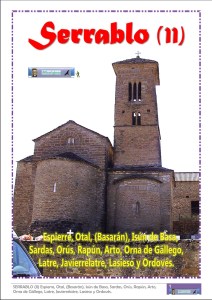
 En esta segunda parte, se complementa algo más esta comarca (a esperas de una tercera).
Encontraras las siguientes visitas:
- Espierre . – Este pequeño núcleo que pertenece al municipio de Biescas y que está un poco complicado para ir. Llegando a Gavín, y desde el Camping local sale un camino que atraviesa la Rambla de Sía, y que continua por el GR-16, y al llegar al desvío de Barbenuta, girar a la derecha y a la entrada, a la izquierda, se encuentra la Iglesia de San Esteban. A 1342m de altitud, en las faldas del monte Erata. Iglesia de San Esteban. Este templo románico del S. XII, que ha tenido numerosas reformas posteriores. Ruinas ermita de Santa María. La ermita de estilo mozárabe serrables del S. X, de nave única rectangular con cabecera recta. Ermita de San Juan. Del S. XI de nave única con su arco de herradura que propicia ser una construcción más antigua de la zona.
- Otal (despoblado) . – Iglesia de San Miguel. Su templo original como el resto de la zona del tipo serrables, data del S. XI en origen era de una sola nave con presbiterio y ábside. Desde el S. XII y el S. XVI tuvo distintas reformas-ampliaciones,
- Sallent de Gállego . – Iglesia de San Urbéz y San Miguel. A inicio de la década de los años 70 del siglo pasado, fue trasladada y reconstruida, si bien hubo alguna recolocación en ubicaciones distintas a la original, y algún elemento nuevo como su torre siguiendo el modelo de la de Láderre
- Isún de Basa . – En la falda sur del monte de Santa Orosia a 960m de altitud esta pequeña población anexo de Sardas. Antiguamente Esun (c.875/904). Iglesia de La Asunción. Este templo se llamó de Santa María de estilo proto románico-mozárabe del S. XI del Serrablo. Y que fue modificado posteriormente.
- Sardas . – Localidad muy cuidada en su construcción de arquitectura popular como se aprecian en sus casas, mayormente restauradas. Iglesia de La Purificación de Ntrª Señora. Pequeño templo del llamado románico rural del S. XII comenzó siendo nave única, tres naves (por las capillas adosadas) y su cabecera con un ábside semicircular
- Orús . – Iglesia de San Juan. Su construcción se remonta a comienzo del S. XII, cuando el románico pleno o jaqués va homogenizar la arquitectura religiosa del Reino de Aragón.
- Rapún . – En los años 60 estuvo deshabitado, y está situada a 846m de altitud. Iglesia de San Félix. Sencillo templo románico rural del S. XI (sobre 1025) con una sola nave, y su cabecera semicircular.
- Arto . – Iglesia de San Martin. , edificio románico del S. XI – XII, de nave rectangular con cabecera en ábside de planta semicircular, aunque sufrió importantes reformas durante los S. XVI y XVII.
- Orna de Gállego . – Iglesia de San Miguel Arcángel. Este templo de estilo románico lombardo, aunque tiene algunos motivos constructivos de influencia jaquesa, se construyó a finales del S. XI.
- Latre .- Localidad con 17 habitantes entre los dos barrios que tiene divididos por los dos barrancos. Iglesia de San Miguel. Parroquial originaria del S. XII con características de la arquitectura románica del Alto Gallego, formada por una nave rectangular, (trasformada en el S. XVIII.
- Javierrelatre . – Esta localidad situada en la margen derecha del río Gállego donde conserva sus construcciones tradicionales de piedra, algunas de ellas destacables. Iglesia de los Santos Reyes. Esta iglesia del S. XVI de la que se encuentran restos de su anterior románica del del pleno medievo, S. XII en su ábside semicircular.
- Lasieso . – Asentado sobre una ladera se ubica este pueblo que ofrece un interesante conjunto arquitectónico. Iglesia de San Pedro. De finales S. XI principios del XII. Es la agrupación de dos iglesias, una la más antigua mozárabe de pequeñas dimensiones sobre la que descansa la torre, y la otra románica.
- Y Ordovés . – Iglesia de San Martín. Del S. XI con nave rectangular de tamaño reducido y con un ábside semicircular.
Puedes descargarte el PDF.
Pulsar sobre la imagen con el botón derecho y guardar como…para descargar y llevar el archivo PDF en tu Tablet o Smartphone toda la información con planos, puntos interesantes a visitar, fotos, contactos, etc. Si te ha parecido interesante y quieres conocer las nuevas publicaciones, solo tienes incluirte en “seguir” para recibirlas por correo electrónico, cada nueva publicación.
-
SERRABLO (II) Espierre, Otal, (Basarán), Isún de Basa, Sardas, Orús, Rapún, Arto, Orna de Gállego, Latre, Javierrelatre, Lasieso, and Ordovés.
In this second part, this region is explored in more detail (awaiting a third part).
You will find the following places to visit:
- Espierre – This small village, belonging to the municipality of Biescas, is a bit difficult to reach. Arriving in Gavín, a path leads from the local campsite across the Rambla de Sía ravine, continuing along the GR-16 trail. Upon reaching the turnoff for Barbenuta, turn right, and at the entrance, on the left, you will find the Church of San Esteban. It sits at an altitude of 1342 meters, on the slopes of Mount Erata. The Church of San Esteban is a 12th-century Romanesque church that has undergone numerous later renovations. Also worth visiting are the ruins of the Hermitage of Santa María. The Mozarabic-style hermitage of the Serrables region, dating from the 10th century, has a single rectangular nave with a straight apse. The Hermitage of San Juan, from the 11th century, also has a single nave with a horseshoe arch, suggesting it is one of the oldest buildings in the area.
- Otal (uninhabited). – Church of San Miguel. Like the other Serrables-style churches in the area, its original temple dates from the 11th century. It originally had a single nave with a presbytery and apse. Between the 12th and 16th centuries, it underwent various renovations and expansions.
- Sallent de Gállego. – Church of San Urbéz and San Miguel. At the beginning of the 1970s, it was moved and rebuilt, although some elements were relocated to different positions from the original, and new elements were added, such as its tower, modeled after the one in Láderre.
- Isún de Basa. – On the southern slope of Mount Santa Orosia, at an altitude of 960m, lies this small hamlet, an annex of Sardas. Formerly known as Esun (c. 875/904). Church of the Assumption. This church was originally called Santa María, built in the proto-Romanesque-Mozarabic style of the Serrablo region in the 11th century. It was later modified.
- Sardas. – A town with well-preserved vernacular architecture, evident in its mostly restored houses. Church of the Purification of Our Lady. A small church in the so-called rural Romanesque style of the 12th century, it began as a single nave, later expanded to three naves (due to attached chapels), and has a semicircular apse.
- Orus. – Church of San Juan. Its construction dates back to the beginning of the 12th century, when the High Romanesque or Jaca style began to homogenize the religious architecture of the Kingdom of Aragon.
- Rapún. In the 1960s it was uninhabited and is located at an altitude of 846m. Church of San Félix. A simple rural Romanesque church from the 11th century (circa 1025) with a single nave and a semicircular apse.
- Arto. – Church of San Martín. A Romanesque building from the 11th-12th centuries, with a rectangular nave and a semicircular apse, although it underwent significant renovations during the 16th and 17th centuries.
- Orna de Gállego. – Church of San Miguel Arcángel. This Lombard Romanesque church, although it has some architectural features influenced by Jaca, was built at the end of the 11th century.
- Latre. A village with 17 inhabitants divided between two neighborhoods by two ravines. Church of San Miguel. Parish church originally from the 12th century with characteristics of the Romanesque architecture of the Alto Gállego region, consisting of a rectangular nave (transformed in the 18th century).
- Javierrelatre – This town, located on the right bank of the Gállego River, preserves its traditional stone buildings, some of them noteworthy. Church of the Holy Kings. This 16th-century church contains remains of its earlier Romanesque structure from the High Middle Ages (12th century) in its semicircular apse.
- Lasieso – Situated on a hillside, this village offers an interesting architectural ensemble. Church of San Pedro. From the late 11th/early 12th century. It is a complex of two churches: the older, smaller Mozarabic church, upon which the tower rests, and the other Romanesque.
- Ordovés – Church of San Martín. From the 11th century, with a small rectangular nave and a semicircular apse.
You can download the PDF.
Right-click on the image and select «Save as…» to download the PDF file to your tablet or smartphone. It contains all the information, including maps, points of interest, photos, contacts, and more. If you found this helpful and would like to receive updates, simply subscribe to «Follow» to be notified by email.
-
SERRABLO (II) Espierre, Otal (Basarán), Isún de Basa, Sardas, Orús, Rapún, Arto, Orna de Gállego, Latre, Javierrelatre, Lasieso et Ordovés.
Dans cette deuxième partie, la région est explorée plus en détail (une troisième partie suivra).
Voici les lieux à visiter :
- Espierre – Ce petit village, appartenant à la commune de Biescas, est un peu difficile d’accès. En arrivant à Gavín, un sentier part du camping local et traverse le ravin de la Rambla de Sía, en suivant le GR-16. À l’embranchement pour Barbenuta, tournez à droite ; à l’entrée, sur votre gauche, vous trouverez l’église San Esteban. Elle se situe à 1 342 mètres d’altitude, sur les pentes du mont Erata. L’église San Esteban est une église romane du XIIe siècle qui a subi de nombreuses rénovations ultérieures. Les ruines de l’ermitage Santa María méritent également une visite. Cet ermitage de style mozarabe, typique de la région des Serrables et datant du Xe siècle, possède une nef rectangulaire unique avec une abside droite. L’ermitage San Juan, du XIe siècle, présente lui aussi une nef unique surmontée d’une arche en fer à cheval, ce qui laisse supposer qu’il s’agit de l’un des plus anciens édifices de la région.
- Otal (inhabité) : église San Miguel. À l’instar des autres églises de style serrables de la région, son édifice d’origine date du XIe siècle. Il comportait initialement une nef unique avec un chœur et une abside. Entre le XIIe et le XVIe siècle, il a fait l’objet de diverses rénovations et agrandissements.
- Sallent de Gállego: églises San Urbéz et San Miguel. Au début des années 1970, l’édifice fut déplacé et reconstruit. Certains éléments furent repositionnés et de nouveaux furent ajoutés, comme sa tour, inspirée de celle de Láderre.
- Isún de Basa. – Sur le versant sud du mont Santa Orosia, à 960 m d’altitude, se trouve ce petit hameau, annexe de Sardas. Autrefois appelé Esun (vers 875/904). Église de l’Assomption. Cette église, initialement nommée Santa María, fut construite au XIe siècle dans le style proto-roman mozarabe de la région du Serrablo. Elle fut ensuite modifiée.
- Sardas. – Ville à l’architecture vernaculaire bien préservée, comme en témoignent ses maisons, pour la plupart restaurées. Église de la Purification de la Vierge Marie. Petite église de style roman rural du XIIe siècle, elle comportait initialement une seule nef, agrandie par la suite à trois nefs (suite à l’ajout de chapelles) et possède une abside semi-circulaire.
- Orús – Église San Juan. Sa construction remonte au début du XIIe siècle, période où le style roman classique, ou style jaca, commença à homogénéiser l’architecture religieuse du royaume d’Aragon.
- Rapún. Inhabité dans les années 1960, ce village est situé à 846 m d’altitude. Église San Félix. Simple église romane rurale du XIe siècle (vers 1025), elle possède une seule nef et une abside semi-circulaire.
- Arto – Église San Martín. Un édifice roman des XIe et XIIe siècles, à nef rectangulaire et abside semi-circulaire, ayant subi d’importantes rénovations aux XVIe et XVIIe siècles.
- Orna de Gállego. – Église San Miguel Arcángel. Cette église romane lombarde, bien que présentant des caractéristiques architecturales influencées par Jaca, fut construite à la fin du XIe siècle.
- Latre. Village de 17 habitants, divisé en deux quartiers par deux ravins. Église San Miguel. Église paroissiale datant du XIIe siècle, caractéristique de l’architecture romane du Haut-Gállego, avec une nef rectangulaire (remaniée au XVIIIe siècle).
- Javierrelatre. Ce village, situé sur la rive droite du Gállego, a conservé ses bâtiments traditionnels en pierre, dont certains sont remarquables. Église des Rois mages. Cette église du XVIe siècle conserve des vestiges de sa structure romane antérieure du Haut Moyen Âge (XIIe siècle) dans son abside semi-circulaire.
- Lasieso – Situé à flanc de colline, ce village offre un ensemble architectural remarquable. L’église San Pedro, datant de la fin du XIe/début du XIIe siècle, est un complexe composé de deux églises : la plus ancienne, de style mozarabe, sur laquelle repose le clocher, et l’autre, de style roman.
- Ordovés – Église San Martín, du XIe siècle, avec une petite nef rectangulaire et une abside semi-circulaire.
Vous pouvez télécharger le PDF.
Faites un clic droit sur l’image et sélectionnez « Enregistrer sous… » pour télécharger le fichier PDF sur votre tablette ou smartphone. Il contient toutes les informations, y compris des cartes, des points d’intérêt, des photos, des contacts, etc. Si vous avez trouvé ces informations utiles et souhaitez recevoir des mises à jour, abonnez-vous simplement à « Suivre » pour être averti par e-mail.
-
SERRABLO (II) Espierre, Otal, (Basarán), Isún de Basa, Sardas, Orús, Rapún, Arto, Orna de Gállego, Latre, Javierrelatre, Lasieso und Ordovés.
In diesem zweiten Teil wird diese Region detaillierter erkundet (ein dritter Teil folgt).
Folgende Orte sind einen Besuch wert:
- Espierre – Dieses kleine Dorf, das zur Gemeinde Biescas gehört, ist etwas schwer zu erreichen. Von Gavín aus führt ein Weg vom örtlichen Campingplatz über die Schlucht Rambla de Sía und weiter entlang des Fernwanderwegs GR-16. An der Abzweigung nach Barbenuta biegen Sie rechts ab. Am Ortseingang, auf der linken Seite, befindet sich die Kirche San Esteban. Sie liegt auf 1342 Metern Höhe an den Hängen des Monte Erata. Die Kirche San Esteban ist eine romanische Kirche aus dem 12. Jahrhundert, die im Laufe der Zeit mehrfach umgebaut wurde. Ebenfalls sehenswert sind die Ruinen der Einsiedelei Santa María. Die Einsiedelei im mozarabischen Stil der Region Serrables stammt aus dem 10. Jahrhundert und besitzt ein rechteckiges Langhaus mit gerader Apsis. Auch die Einsiedelei San Juan aus dem 11. Jahrhundert hat ein Langhaus mit Hufeisenbogen, was darauf hindeutet, dass sie zu den ältesten Gebäuden der Gegend zählt.
- Otal (unbewohnt). – Kirche San Miguel. Wie die anderen Kirchen im Serrables-Stil in der Gegend stammt ihr ursprünglicher Bau aus dem 11. Jahrhundert. Sie besaß ursprünglich ein Langhaus mit Chor und Apsis. Zwischen dem 12. und 16. Jahrhundert wurde sie mehrfach umgebaut und erweitert.
- Sallent de Gállego. – Kirche San Urbéz und San Miguel. Anfang der 1970er Jahre wurde die Kirche versetzt und wiederaufgebaut. Dabei wurden einige Elemente an andere Positionen als ursprünglich gesetzt und neue hinzugefügt, beispielsweise der Turm, der dem Turm in Láderre nachempfunden ist.
- Isún de Basa – Am Südhang des Monte Santa Orosia, auf 960 m Höhe, liegt dieser kleine Weiler, ein Ortsteil von Sardas. Früher bekannt als Esun (ca. 875/904). Kirche Mariä Himmelfahrt. Diese Kirche hieß ursprünglich Santa María und wurde im 11. Jahrhundert im proto-romanisch-mozarabischen Stil der Serrablo-Region erbaut. Später wurde sie umgebaut.
- Sardas – Ein gut erhaltenes Dorf mit reicher, traditioneller Architektur, die sich in den größtenteils restaurierten Häusern widerspiegelt. Kirche Mariä Reinigung Eine kleine Kirche im sogenannten ländlichen romanischen Stil des 12. Jahrhunderts. Sie begann als einschiffige Kirche, wurde später durch angebaute Kapellen auf drei Schiffe erweitert und besitzt eine halbrunde Apsis.
- Orús – Kirche San Juan. Ihr Bau datiert auf den Beginn des 12. Jahrhunderts, als der hochromanische oder Jaca-Stil die Sakralarchitektur des Königreichs Aragon vereinheitlichte.
- Rapún – In den 1960er Jahren unbewohnt, liegt sie auf einer Höhe von 846 m. Kirche San Félix. Eine schlichte ländliche romanische Kirche aus dem 11. Jahrhundert (um 1025) mit einem einzigen Schiff und einer halbrunden Apsis.
- Arto – Kirche San Martín. Ein romanisches Gebäude aus dem 11./12. Jahrhundert mit rechteckigem Langhaus und halbrunder Apsis, das im 16. und 17. Jahrhundert umfassend renoviert wurde.
- Orna de Gállego – Kirche San Miguel Arcángel. Diese lombardisch-romanische Kirche, die zwar einige architektonische Merkmale des Jaca-Stils aufweist, wurde Ende des 11. Jahrhunderts erbaut.
- Latre. Ein Dorf mit 17 Einwohnern, das sich zwischen zwei Schluchten erstreckt. Kirche San Miguel. Pfarrkirche, ursprünglich aus dem 12. Jahrhundert, mit Merkmalen der romanischen Architektur der Region Alto Gállego. Sie besteht aus einem rechteckigen Langhaus (im 18. Jahrhundert umgebaut).
- Javierrelatre – Dieser Ort am rechten Ufer des Flusses Gállego bewahrt seine traditionellen Steingebäude, von denen einige bemerkenswert sind. Kirche der Heiligen Könige. Diese Kirche aus dem 16. Jahrhundert birgt in ihrer halbrunden Apsis Überreste ihres früheren romanischen Baus aus dem Hochmittelalter (12. Jahrhundert).
- Lasieso – Dieses auf einem Hügel gelegene Dorf bietet ein interessantes architektonisches Ensemble. Die Kirche San Pedro stammt aus dem späten 11./frühen 12. Jahrhundert und besteht aus zwei Kirchen: der älteren, kleineren mozarabischen Kirche, auf der der Turm ruht, und der anderen, romanischen Kirche.
- Ordovés – Kirche San Martín aus dem 11. Jahrhundert mit einem kleinen rechteckigen Kirchenschiff und einer halbrunden Apsis.
Sie können die PDF-Datei herunterladen.
Klicken Sie mit der rechten Maustaste auf das Bild und wählen Sie „Speichern unter…“, um die PDF-Datei auf Ihr Tablet oder Smartphone herunterzuladen. Sie enthält alle Informationen, darunter Karten, Sehenswürdigkeiten, Fotos, Kontaktdaten und mehr. Wenn Ihnen diese Informationen hilfreich waren und Sie über Neuigkeiten informiert werden möchten, abonnieren Sie einfach die „Folgen“-Funktion, um per E-Mail benachrichtigt zu werden.
 Salidas