
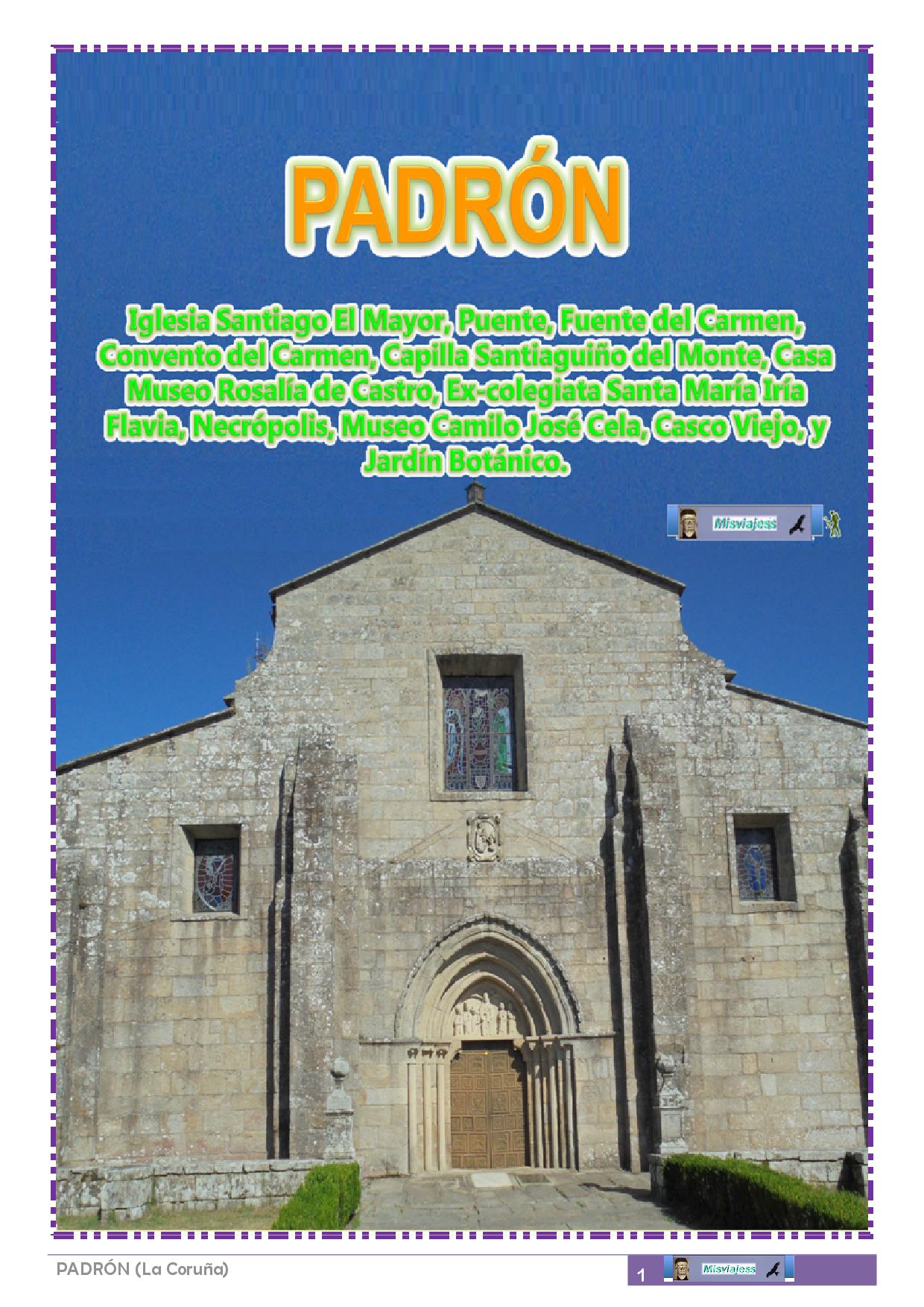
 Interesante localidad que con su tradición Jacobea, en torno al traslado del Cuerpo del Santiago a esta localidad, la predicación del apóstol en Santiaguiño del Monte, y la catedral de Iría Flavia, que existió antes que la de Santiago de Compostela.
Encontraras las siguientes visitas:
- El paseo del Espolón es la entrada de los peregrinos en Padrón con los monumentos s Cela y Rosalía de Castro.
- Iglesia de Santiago El Mayor.- En este templo se guarda O Pedrón, testimonio realizado en piedra (es una ara romana) con inscripciones situado bajo el altar. La historia cuenta que a esta piedra se amarró la barca que traía los restos del cuerpo de Santiago del puerto de Jaffa (Israel). En él los elementos relacionados con Santiago son numerosos.
- El Puente, que traviesa el curso del río Sar.
- Fuente del Carmen.– Esta construcción se realizó en el año 1577 y de ella mana agua natural, tiene tres cuerpos: en el inferior se encuentra la Virgen de los Dolores, el cuerpo central se encuentra el “traslatio” del apóstol Santiago por sus discípulos a tierras gallegas, y el arco de medio punto superior coronado con un frontis triangular con un óculo, se encuentra el Bautismo de la reina Lupa por Santiago.
- Convento del Carmen.- De 1752 regentado por los Padres Dominicos, es un edificio neoclásico que fue construido a principios del S. XVIII, sobre la roca viva existente en el monte de San Gregorio, fue de la orden de los Carmelitas inicialmente y tras la desamortización de Mendizabal (1836) lo regentan los dominicos.
- Capilla Santiaguiño del Monte.- No se conoce la fecha de construcción pero si de la reconstrucción que se efectuó en el S. XV. En la puerta de la fachada este hay un relieve con el bautismo de la Reina Lupa por parte del Apóstol. En esta capilla que cuenta con un altar dedicado al apóstol con una estatua pétrea, en unas rocas que la tradición cuenta que predico el hijo de Zebedeo y Salomé. Y otra imagen dentro de la capilla y el sepulcro del canónigo Gregorio S. XV. A la entrada hay un curioso reloj de sol con tres caras.
- Casa Museo de Rosalía de Castro.- Esta considerada entre los grandes poetas de la literatura española del S. XIX, aunque en esta época el escribir en gallego no le facilitaba las cosas.
- Iría Flavia.- Situada en la confluencia de los ríos Sar y Ulla, fue una ciudad galaica. Ciudad romana y posteriormente sede episcopal hasta el S. XI.
- Ex Colegiata de Santa María.- Su templo primitivo visigodo (sede episcopal sufragánea de la mitra de Braga) y después pre-románico fue destruido por Almanzor en el 999, y el arzobispo Gelmírez ordena su reconstrucción en la segunda mitad del S. XII y principios del XII. Del que no ha quedado nada salvo su portada romanica.
- Necrópolis.- Colindante se encuentra el Cementerio que durante el periodo de reconstrucción apareció una importante necrópolis tardo romana y Gallaecia tardo-antigua. Apareciendo un conjunto de casi una treintena de sarcófagos de diversas formas alto medievales de los S. VI y X. con decoraciones de las características “estolo” suévica, representación esquemática del orante.
- Museo de Camilo José Cela.- Con una gran extensión pues ocupa cuatro, de las ocho casas de los canónigos y un amplio jardín, está gestionado por la Fundación del premio Nobel desde 1991.
Para darse una idea de su extensión dispone de 11.000 m2 y solo en su biblioteca atesora más de 45.000 volúmenes, también posee una pinacoteca con más de 700 pinturas.
- Recorrer el Casco Viejo, con el Pazo del Obispo de Quito, la iglesia de San Antonio de la Orden Tercera.
- Y el Jardín Botánico.- Este antiguo jardín que atestigua documentación del mismo allá en 1869 y que lo convierte en uno de los jardines más antiguos españoles. Tiene una extensión de una hectárea se concentran más de 300 especies, entre los que se encuentran algunos árboles singulares.
Puedes descargarte el PDF.
Pulsar sobre la imagen con el botón derecho y guardar como…para descargar y llevar el archivo PDF en tu tablet o Smartphone toda la información con planos, puntos interesantes a visitar, fotos, contactos, etc. Y si deseas conocer las nuevas publicaciones solo tienes incluirte en seguir para recibirlas por correo electrónico.
-
PADRON Jacobean Town. Santiago El Mayor Church, Bridge, Fuente del Carmen, Convent of Carmen, Santiaguiño del Monte chapel, Rosalía de Castro House Museum, Former Santa María de Iría Flavia collegiate church, Necropolis, Camilo José Cela Museum, Old Town and Botanical Garden.
Interesting town with its Jacobean tradition, around the transfer of the Body of Saint James to this town, the preaching of the apostle in Santiaguiño del Monte, and the cathedral of Iría Flavia, which existed before that of Santiago de Compostela.
You will find the following visits:
- The Espolón Walk is the entrance for pilgrims to Padrón with the monuments Cela and Rosalía de Castro.
- Church of Santiago El Mayor.- O Pedrón is kept in this temple, a testimony made of stone (it is a Roman altar) with inscriptions located under the altar. The story goes that the boat that brought the remains of Santiago’s body from the port of Jaffa (Israel) was tied to this stone. In it the elements related to Santiago are numerous.
- The Bridge, which crosses the course of the Sar River.
- Carmen Fountain.- This construction was built in the year 1577 and natural water flows from it, it has three bodies: in the lower one is the Virgin of Sorrows, the central body is the “traslatio” of the apostle Santiago for his disciples to Galician lands, and the upper semicircular arch crowned with a triangular frontispiece with an oculus, is the Baptism of Queen Lupa by Santiago.
- Convent of Carmen.- From 1752 run by the Dominican Fathers, it is a neoclassical building that was built at the beginning of the 18th century, on the living rock existing on the San Gregorio mountain, it was from the order of the Carmelites initially and later the confiscation of Mendizabal (1836) is run by the Dominicans.
- Santiaguiño del Monte Chapel.- The date of construction is not known, but the reconstruction that took place in the 15th century is known. On the door of the east façade there is a relief with the baptism of Queen Lupa by the Apostle. In this chapel that has an altar dedicated to the apostle with a stone statue, on some rocks that tradition says that the son of Zebedee and Salome preached. And another image inside the chapel and tomb of Canon Gregory S. XV. At the entrance there is a curious sundial with three faces.
- Rosalía de Castro House Museum.- She is considered among the great poets of Spanish literature of the 19th century, although at this time writing in Galician did not make things easier for her.
- Iría Flavia.- Located at the confluence of the Sar and Ulla rivers, it was a Galician city. Roman city and later episcopal seat until the 11th century.
- Former Collegiate Church of Santa María.- Its primitive Visigoth temple (suffragan episcopal seat of the miter of Braga) and later pre-Romanesque was destroyed by Almanzor in 999, and Archbishop Gelmírez ordered its reconstruction in the second half of the 12th century. and beginning of the XII. Of which nothing has remained except its cover.
- Necropolis.- Adjacent is the Cemetery that during the reconstruction period appeared an important late Roman necropolis and late-ancient Gallaecia. Appearing a set of almost thirty sarcophagi of various early medieval shapes from the 6th and 10th centuries with decorations of the characteristic Suevic “stole”, a schematic representation of the praying person.
- Camilo José Cela Museum.- With a large area as it occupies four of the eight houses of the canons and a large garden, it has been managed by the Nobel Prize Foundation since 1991.
To give you an idea of its extension, it has 11,000 m2 and its library alone houses more than 45,000 volumes, it also has an art gallery with more than 700 paintings.
- Tour the Old Town, with the Pazo del Obispo de Quito, the church of San Antonio of the Third Order.
- And the Botanical Garden.– This old garden that witnesses documentation of it back in 1869 and that makes it one of the oldest Spanish gardens. It has an area of one hectare and contains more than 300 species, among which are some unique trees.
You can download the PDF.
Click on the image with the right button and save as… to download and take the PDF file on your tablet or Smartphone all the information with plans, interesting points to visit, photos, contacts, etc. And if you want to know the new publications, you just have to include yourself in follow to receive them by email.
-
PADRON Village jacobéen. Église Santiago El Mayor, pont, Fuente del Carmen, couvent du Carmen, chapelle Santiaguiño del Monte du Mont, maison-musée Rosalía de Castro, ancienne collégiale Santa María de Iría Flavia, nécropole, musée Camilo José Cela, vieille ville et jardin botanique.
Ville intéressante avec sa tradition jacobéenne, autour du transfert du Corps de Saint Jacques dans cette ville, de la prédication de l’apôtre à Santiaguiño del Monte et de la cathédrale d’Iria Flavia, qui existait avant celle de Saint-Jacques-de-Compostelle.
Vous retrouverez les visites suivantes :
- Le Promenade à Espolón est l’entrée des pèlerins à Padrón avec les monuments Cela et Rosalía de Castro.
- Église de Saint Jaques le Maire.-O Pedrón est conservé dans ce temple, un témoignage en pierre (c’est un autel romain) avec des inscriptions situées sous l’autel. L’histoire raconte que le bateau qui transportait les restes du corps de Santiago du port de Jaffa (Israël) était attaché à cette pierre. Les éléments liés à Santiago y sont nombreux.
- Le Pont qui enjambe le cours de la rivière Sar.
- Fontaine Carmen.- Cette construction a été construite en 1577 et de l’eau naturelle en coule, elle comporte trois corps : dans celui du bas se trouve la Vierge des Douleurs, le corps central est la « traslatio » de l’apôtre Santiago pour son disciples des terres galiciennes, et l’arc semi-circulaire supérieur couronné d’un frontispice triangulaire avec un oculus, est le baptême de la reine Lupa par Santiago.
- Couvent du Carmen.- Depuis 1752, dirigé par les Pères Dominicains, c’est un édifice néoclassique qui a été construit au début du XVIIIe siècle, sur le rocher vivant existant sur la montagne de San Gregorio, il était initialement de l’ordre des Carmes. et plus tard la confiscation de Mendizabal (1836) est opérée par les Dominicains.
- Chapelle Santiaguiño du Mont.- La date de construction n’est pas connue, mais la reconstruction qui a eu lieu au XVe siècle est connue. Sur la porte de la façade est se trouve un relief représentant le baptême de la reine Lupa par l’Apôtre. Dans cette chapelle qui possède un autel dédié à l’apôtre avec une statue en pierre, sur quelques rochers que la tradition dit que prêchait le fils de Zébédée et Salomé. Et une autre image à l’intérieur de la chapelle et du tombeau du chanoine Grégoire S. XV. A l’entrée se trouve un curieux cadran solaire à trois faces.
- Maison-Musée Rosalía de Castro.- Elle est considérée comme l’une des grandes poétesses de la littérature espagnole du XIXe siècle, même si à cette époque, écrire en galicien ne lui facilitait pas les choses.
- Iría Flavia.- Située au confluent des rivières Sar et Ulla, c’était une ville galicienne. Ville romaine puis siège épiscopal jusqu’au XIe siècle.
- Ancienne Collégiale de Santa María.- Son temple primitif wisigoth (siège épiscopal suffragant de la mitre de Braga) et postérieurement préroman fut détruit par Almanzor en 999 et l’archevêque Gelmírez ordonna sa reconstruction dans la seconde moitié du XIIe siècle. et début du XII. Dont il ne reste plus que sa couverture.
- Nécropole.- À côté se trouve le Cimetière qui, pendant la période de reconstruction, est apparue une importante nécropole romaine tardive et Gallaecia de l’Antiquité tardive. Apparaît un ensemble de près d’une trentaine de sarcophages de formes diverses du début du Moyen Âge, des VIe et Xe siècles, avec des décorations de la caractéristique « étole » souève, une représentation schématique de la personne en prière.
- Musée Camilo José Cela.- D’une grande superficie puisqu’il occupe quatre des huit maisons des chanoines et un grand jardin, il est géré par la Fondation du Prix Nobel depuis 1991.
Pour vous donner une idée de son extension, elle compte 11 000 m2 et sa bibliothèque abrite à elle seule plus de 45 000 volumes, elle possède également une galerie d’art avec plus de 700 tableaux.
- Visitez la vieille ville, avec le Pazo del Obispo de Quito, l’église de San Antonio de la Orden Tercera.
- Et le Jardin Botanique.- Cet ancien jardin dont la documentation remonte à 1869 et qui en fait l’un des plus anciens jardins espagnols. Il a une superficie d’un hectare et contient plus de 300 espèces, parmi lesquelles des arbres uniques.
Vous pouvez télécharger le PDF.
Cliquez sur l’image avec le bouton droit et enregistrez sous… pour télécharger et emporter au format PDF sur votre tablette ou Smartphone toutes les informations avec les plans, les points intéressants à visiter, les photos, les contacts, etc. Et si vous souhaitez connaître les nouvelles publications, il vous suffit de vous inclure dans le suivi pour les recevoir par email.
-
PADRON Jakobsstadt. Kirche Santiago der Ältere, Brücke, Fuente del Carmen Carmenbrunnen, Kloster Carmen, Kapelle Santiaguiño del Monte, Hausmuseum Rosalía de Castro, ehemalige Stiftskirche Santa María de Iría Flavia, Nekropole, Museum Camilo José Cela, Altstadt und Botanischer Garten.
Interessante Stadt mit jakobinischer Tradition, rund um die Überführung des Leichnams des Heiligen Jakobus in diese Stadt, die Predigt des Apostels in Santiaguiño del Monte und die Kathedrale von Iría Flavia, die vor der von Santiago de Compostela existierte.
Folgende Besichtigungen finden Sie vor:
- Der Espolón-Spaziergang ist der Eingang für Pilger nach Padrón mit den Denkmälern Cela und Rosalía de Castro.
- Kirche Santiago der Ältere. – In diesem Tempel wird O Pedrón aufbewahrt, ein Zeugnis aus Stein (es handelt sich um einen römischen Altar) mit Inschriften unter dem Altar. Die Geschichte besagt, dass das Boot, das die Überreste von Santiagos Leichnam aus dem Hafen von Jaffa (Israel) brachte, an diesem Stein festgemacht war. Darin gibt es zahlreiche Elemente, die sich auf Santiago beziehen.
- Die Brücke, die den Fluss Sar überquert.
- Carmenbrunnen.- Dieses Bauwerk wurde im Jahr 1577 erbaut und aus ihm fließt natürliches Wasser. Es besteht aus drei Körpern: Im unteren Körper befindet sich die Jungfrau der Schmerzen, im mittleren Körper befindet sich die „Traslatio“ des Apostels Santiago Jünger in galizische Länder, und der obere Halbkreisbogen, gekrönt von einem dreieckigen Frontispiz mit Oculus, ist die Taufe der Königin Lupa durch Santiago.
- Kloster Carmen. – Ab 1752 von den Dominikanerpatres verwaltet, handelt es sich um ein neoklassizistisches Gebäude, das zu Beginn des 18. Jahrhunderts auf dem lebenden Felsen auf dem Berg San Gregorio erbaut wurde und ursprünglich dem Orden der Karmeliter gehörte und später wird die Beschlagnahmung von Mendizabal (1836) von den Dominikanern durchgeführt.
- Kapelle Santiaguiño vom Berg. – Das Datum des Baus ist nicht bekannt, aber der Wiederaufbau im 15. Jahrhundert ist bekannt. An der Tür der Ostfassade befindet sich ein Relief mit der Taufe von Königin Lupa durch den Apostel. In dieser Kapelle befindet sich ein dem Apostel gewidmeter Altar mit einer Steinstatue. Auf einigen Felsen soll der Überlieferung nach der Sohn des Zebedäus und der Salome gepredigt haben. Und ein weiteres Bild in der Kapelle und im Grab von Canon Gregory S. XV. Am Eingang befindet sich eine merkwürdige Sonnenuhr mit drei Gesichtern.
- Rosalía de Castro-Hausmuseum. – Sie gilt als eine der großen Dichterinnen der spanischen Literatur des 19. Jahrhunderts, obwohl es ihr zu dieser Zeit nicht leichter fiel, auf Galizisch zu schreiben.
- Iría Flavia. – Sie lag am Zusammenfluss der Flüsse Sar und Ulla und war eine galizische Stadt. Römische Stadt und später Bischofssitz bis zum 11. Jahrhundert.
- Ehemalige Stiftskirche Santa María. – Ihr ursprünglicher westgotischer Tempel (suffraganischer Bischofssitz der Mitra von Braga) und später vorromanischer Bauart wurde 999 von Almanzor zerstört, und Erzbischof Gelmírez ordnete seinen Wiederaufbau in der zweiten Hälfte des 12. Jahrhunderts an. und Anfang des XII. Von dem bis auf die Hülle nichts übrig geblieben ist.
- Nekropole.- Angrenzend befindet sich der Friedhof, der während des Wiederaufbaus als wichtige spätrömische Nekropole und spätantike Gallaecia diente. Es handelt sich um einen Satz von fast dreißig Sarkophagen verschiedener frühmittelalterlicher Formen aus dem 6. und 10. Jahrhundert mit Verzierungen der charakteristischen suevischen „Stola“, einer schematischen Darstellung der betenden Person.
- Camilo José Cela Museum. – Mit einer großen Fläche, da es vier der acht Häuser der Kanoniker einnimmt, und einem großen Garten, wird es seit 1991 von der Nobelpreisstiftung verwaltet.
Um Ihnen eine Vorstellung von seiner Ausdehnung zu geben: Es hat eine Fläche von 11.000 m² und allein seine Bibliothek beherbergt mehr als 45.000 Bände, außerdem gibt es eine Kunstgalerie mit mehr als 700 Gemälden.
- Besichtigen Sie die Altstadt mit dem Pazo del Obispo de Quito und der Kirche San Antonio de la Orden Tercera.
- Und der Botanische Garten. – Dieser alte Garten wurde bereits 1869 urkundlich erwähnt und ist damit einer der ältesten Gärten Spaniens. Es hat eine Fläche von einem Hektar und beherbergt mehr als 300 Arten, darunter einige einzigartige Bäume.
Sie können das PDF herunterladen.
Klicken Sie mit der rechten Maustaste auf das Bild und speichern Sie es unter…, um die PDF-Datei mit Plänen, interessanten Sehenswürdigkeiten, Fotos, Kontakten usw. herunterzuladen und auf Ihr Tablet oder Smartphone zu übertragen. Und wenn Sie die neuen Veröffentlichungen kennenlernen möchten, müssen Sie sich nur bei „Folgen“ eintragen, um sie per E-Mail zu erhalten.
 Salidas