
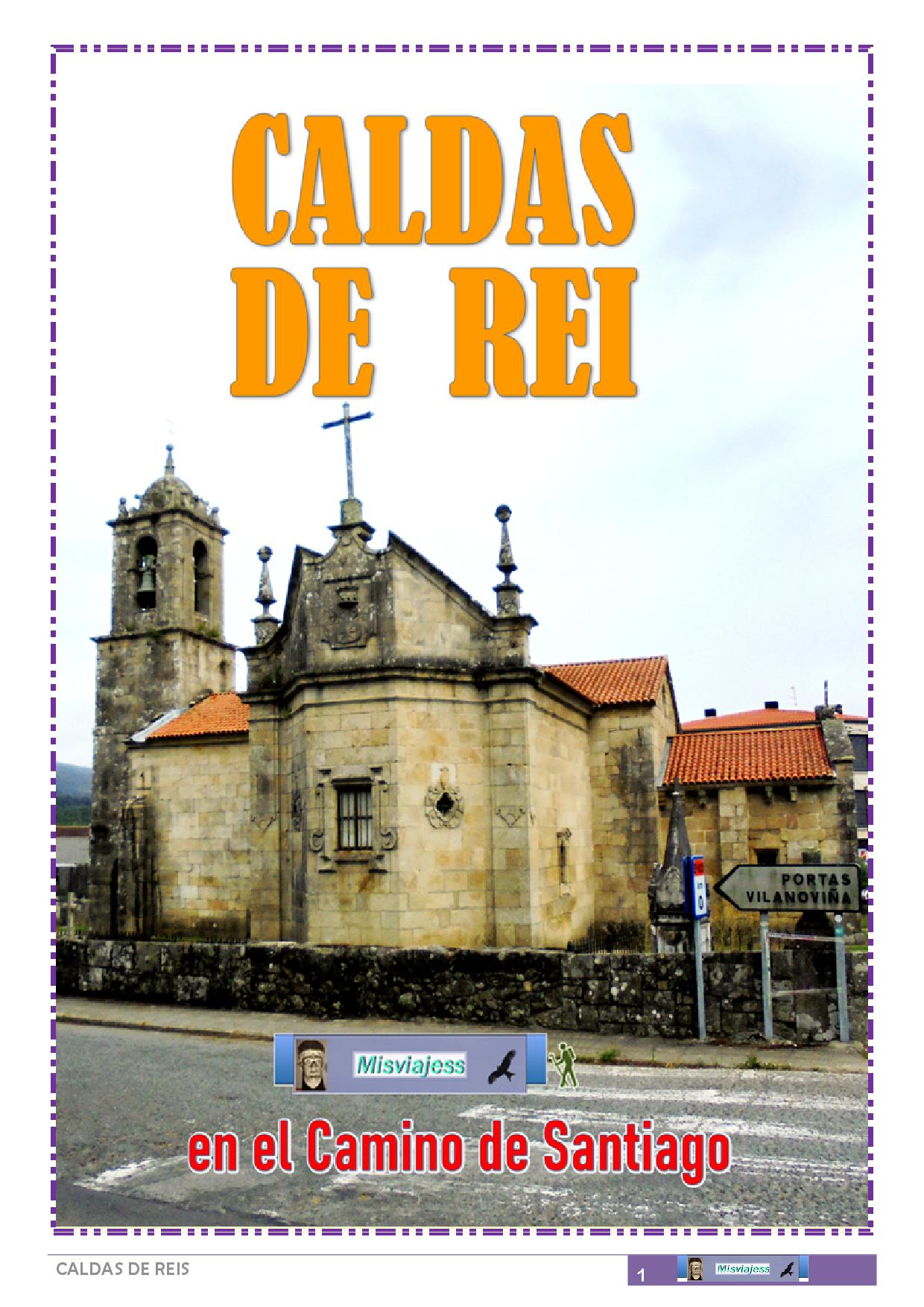
 Localidad visitada realizando la etapa de Pontevedra a Caldas del Camino Portugués por la Costa, que tiene un importante atractivo histórico como artístico y gastronómico. Además de sus establecimientos termales.
Encontraras las siguientes visitas:
- La Iglesia de Santa María.- También es un templo que fue trasformado su origen románico y con ampliaciones. Según las crónicas su anterior iglesia de alrededor del año 1000 (y que fue construida sobre la que Almanzor arraso), lo más antiguo que posee actualmente, algo posterior a finales del S, XII.
- Ayuntamiento.– Edificio que podría ser finales del S. XIX de planta rectangular y en su interior posee un patio consta de dos plantas y construido con piedra sillar de granito.
- Puente de Umía.- Posee con cinco arcos rebajados con sendos tajamares, es el más grande del municipio. Por el mismo lleva el tráfico de la N- 550. A partir de este puente, aguas arriba se puede realizar la ruta del Agua.
- Balnearios.- Cuenta con dos establecimientos hoteleros el Acuña y el Dávila. Este último tiene un exótico complemento, un cañaveral de bambú negro que los propietarios se trajeron de Filipinas. En estos establecimientos termales sus aguas son beneficiosas para tratar las vías respiratorias, la piel, los huesos, etc.
- Fuente de Burgas.- En estilo neoclásico por sus ornamentación y construida en el año 1881. Su agua mana constantemente a 48º y se le atribuyen propiedades medicinales
- Iglesia de Santo Tomás Becket.- Esta advocación es la única iglesia dedicada a este santo ingles en toda Galicia. Construida en el S. XIX (1890-1894) y emplearon piedras de la torre de Doña Urraca que desmontaron.
- Puente de Bermaña.- La estructura de este puente fue reedificada en el S. XVI. Y en el centro del mismo ostenta un crucero.
- Jardín Botánico.- Catalogado como Jardín Histórico, se encuentra en el centro urbano al lado del río Umia, en este lado de la ribera dispone de un paseo fluvial con un malecón.
- Capilla de San Roque.- Templo de planta rectangular construido con piedra sillar y cubierta a dos aguas del S. XV.
- Y la visita a las iglesias románicas de Iglesia de San André de Cesar del S. XII, Iglesia de Santa María de Bemil, ambas del XII y la Iglesia San Estevo de Saiar.
Puedes descargarte el PDF.
Pulsar sobre la imagen con el botón derecho y guardar como…para descargar y llevar el archivo PDF en tu tablet o Smartphone toda la información con planos, puntos interesantes a visitar, fotos, contactos, etc. Y si deseas conocer las nuevas publicaciones solo tienes incluirte en seguir para recibirlas por correo electrónico.
-
CALDAS DE REY Santa María Church, Town Hall, Umía Bridge, Spas, Burgas Fountain, Santo Tomás Becket Church, Bermaña Bridge, and Botanical Garden.
A town visited on the Pontevedra to Caldas stage of the Portuguese Way along the Coast, which has an important historical, artistic and gastronomic attraction. In addition to its thermal establishments.
You will find the following visits:
- The Church of Santa María.- It is also a temple that was transformed from its Romanesque origin and with extensions. According to the chronicles, its previous church from around the year 1000 (and which was built on the one that Almanzor destroyed), is the oldest thing it currently has, somewhat later than the end of the 12th century.
- Town Hall.- A building that could be from the end of the 19th century with a rectangular floor plan and inside it has a patio consisting of two floors and built with granite ashlar stone.
- Umía Bridge.- It has five lowered arches with separate breakwaters, and is the largest in the municipality. The N-550 carries traffic through it. From this bridge, upstream, you can take the Water Route.
- Spas.- It has two hotel establishments, the Acuña and the Dávila. The latter has an exotic complement, a black bamboo cane field that the owners brought from the Philippines. In these thermal establishments, the waters are beneficial for treating the respiratory tract, the skin, the bones, etc.
- Burgas Fountain.- In neoclassical style due to its ornamentation and built in 1881. Its water constantly flows at 48º and medicinal properties are attributed to it
- Church of Santo Tomás Becket.- This devotion is the only church dedicated to this English saint in all of Galicia. Built in the 19th century (1890-1894) and they used stones from the tower of Doña Urraca that were dismantled.
- Bermaña Bridge.- The structure of this bridge was rebuilt in the 16th century. And in the centre of it there is a cross.
- Botanical Garden.- Classified as a Historical Garden, it is located in the city centre next to the Umia River, on this side of the riverbank there is a river walk with a jetty.
- San Roque Chapel.– Rectangular temple built with ashlar stone and a gabled roof from the 15th century.
- And the visit to the Romanesque churches of the Church of San André de Cesar from the 12th century, the Church of Santa María de Bemil, both from the 12th century and the Church of San Estevo de Saiar.
You can download the PDF.
Right click on the image and save as… to download and take the PDF file to your tablet or Smartphone with all the information with maps, interesting places to visit, photos, contacts, etc. And if you want to know about new publications, just follow me to receive them by email.
-
CALDAS DE REY Église Santa María, Hôtel de Ville, Pont Umía, Spas, Fontaine de Burgas, Église Santo Tomás Becket, Pont Bermaña et Jardin Botanique.
Ville visitée lors de l’étape Pontevedra-Caldas du Chemin du Littoral Portugais, qui présente un important attrait historique, artistique et gastronomique. En plus de ses établissements thermaux.
Vous retrouverez les visites suivantes :
- L’église de Santa María.- C’est aussi un temple transformé depuis son origine romane et avec des extensions. Selon les chroniques, son église précédente date d’environ l’an 1000 (et a été construite sur celle qu’Almanzor a rasée), la plus ancienne église dont elle dispose actuellement, quelque chose après la fin du XIIe siècle.
- Hôtel de Ville.– Bâtiment qui pourrait dater de la fin du XIXe siècle avec un plan rectangulaire et à l’intérieur il dispose d’un patio composé de deux étages et construit en pierre de taille de granit.
- Pont d’Umía.- Il possède cinq arches surbaissées et deux brise-lames, c’est le plus grand de la commune. Le trafic de la N-550 le traverse. Depuis ce pont, en amont, on peut emprunter la Route de l’Eau.
- Spas.- Elle dispose de deux établissements hôteliers, Acuña et Dávila. Ce dernier a un complément exotique, une canne de bambou noir que les propriétaires ont rapportée des Philippines. Dans ces établissements thermaux, leurs eaux sont bénéfiques pour soigner les voies respiratoires, la peau, les os, etc.
- Fontaine de Bourgas.- De style néoclassique en raison de son ornementation et construite en 1881. Son eau coule constamment à 48º et on lui attribue des propriétés médicinales.
- Église de Santo Tomás Becket.- Cette dédicace est la seule église dédiée à ce saint anglais dans toute la Galice. Construit au XIXe siècle (1890-1894) et utilisé les pierres de la tour Doña Urraca qu’ils ont démontée.
- Pont Bermaña.- La structure de ce pont a été reconstruite au XVIe siècle. Et au centre se trouve un bateau de croisière.
- Jardin Botanique.- Classé Jardin Historique, il est situé dans le centre urbain à côté de la rivière Umia, de ce côté de la rive il dispose d’une promenade fluviale avec une promenade en bois.
- Chapelle de San Roque.- Temple de plan rectangulaire construit en pierre de taille et avec un toit à deux versants du XVe siècle.
- Et la visite des églises romanes de l’église de San André de Cesar du XIIe siècle, de l’église de Santa María de Bemil, toutes deux du XIIe siècle, et de l’église de San Estevo de Saiar.
Vous pouvez télécharger le PDF.
Cliquez sur l’image avec le bouton droit et enregistrez sous… pour télécharger et emporter au format PDF sur votre tablette ou Smartphone toutes les informations avec les plans, les points intéressants à visiter, les photos, les contacts, etc. Et si vous souhaitez connaître les nouvelles publications, il vous suffit de vous inclure dans le suivi pour les recevoir par email.
-
CALDAS DE REY Santa María-Kirche, Rathaus, Umía-Brücke, Thermen, Burgas-Brunnen, Kirche Santo Tomás Becket, Bermaña-Brücke und Botanischer Garten.
Stadt, die während der Etappe von Pontevedra nach Caldas des portugiesischen Küstenweges besucht wird und eine wichtige historische, künstlerische und gastronomische Attraktion aufweist. Zusätzlich zu seinen Thermaleinrichtungen.
Folgende Besichtigungen finden Sie vor:
- Die Kirche Santa María. – Es handelt sich ebenfalls um einen Tempel, der von seinem romanischen Ursprung an umgebaut und erweitert wurde. Den Chroniken zufolge stammt die vorherige Kirche aus der Zeit um das Jahr 1000 (und wurde auf der Kirche errichtet, die Almanzor dem Erdboden gleichgemacht hatte), die älteste Kirche, die es derzeit gibt, etwa nach dem Ende des 12. Jahrhunderts.
- Rathaus. – Gebäude, das aus dem Ende des 19. Jahrhunderts stammen könnte, mit rechteckigem Grundriss und innen mit einem zweistöckigen Innenhof aus Granitquadern.
- Umía-Brücke. – Sie hat fünf abgesenkte Bögen mit zwei Wellenbrechern und ist die größte in der Gemeinde. Der Verkehr der N-550 verläuft durch sie. Von dieser Brücke aus können Sie flussaufwärts die Wasserstraße nehmen.
- Spas: Es verfügt über zwei Hotelbetriebe, Acuña und Dávila. Letzteres hat eine exotische Ergänzung, einen schwarzen Bambusstock, den die Besitzer von den Philippinen mitgebracht haben. In diesen Thermalbädern wirkt das Wasser wohltuend auf die Behandlung der Atemwege, der Haut, der Knochen usw.
- Burgas-Brunnen. – Aufgrund seiner Verzierungen im neoklassizistischen Stil gehalten und 1881 erbaut. Sein Wasser fließt konstant bei 48° und ihm werden medizinische Eigenschaften zugeschrieben.
- Kirche von Santo Tomás Becket. – Diese Widmung ist die einzige Kirche, die diesem englischen Heiligen in ganz Galizien gewidmet ist. Erbaut im 19. Jahrhundert (1890-1894) und unter Verwendung von Steinen des Turms Doña Urraca, den sie abgebaut hatten.
- Bermaña-Brücke. – Die Struktur dieser Brücke wurde im 16. Jahrhundert wieder aufgebaut. Und in der Mitte steht ein Kreuzfahrtschiff.
- Botanischer Garten. – Er steht unter Denkmalschutz und liegt im Stadtzentrum neben dem Umia-Fluss. Auf dieser Seite des Ufers gibt es einen Flussweg mit einer Promenade.
- Kapelle San Roque. – Tempel mit rechteckigem Grundriss aus Quadersteinen und Satteldach aus dem 15. Jahrhundert.
- Und der Besuch der romanischen Kirchen der Kirche San André de Cesar aus dem 12. Jahrhundert, der Kirche Santa María de Bemil, beide aus dem 12. Jahrhundert, und der Kirche San Estevo de Saiar.
Sie können das PDF herunterladen.
Klicken Sie mit der rechten Maustaste auf das Bild und speichern Sie es unter…, um die PDF-Datei mit Plänen, interessanten Sehenswürdigkeiten, Fotos, Kontakten usw. herunterzuladen und auf Ihr Tablet oder Smartphone zu übertragen. Und wenn Sie die neuen Veröffentlichungen erfahren möchten, müssen Sie sich nur bei „Folgen“ eintragen, um sie per E-Mail zu erhalten.
 Salidas