
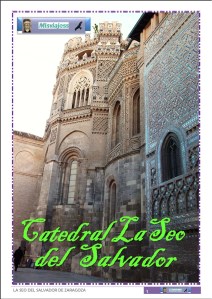
 Es una de las visitas imprescindibles, para que te tomes algo más de 2 horas, y ampliable al resto de la mañana recorriendo los otros puntos de esta plaza de las Catedrales o del Pilar.
Encontraras los siguientes puntos:
- Es interesante con anterioridad recorrer los espacios exteriores en la calle del Sepulcro y la Glorieta de San Bruno, son los más antiguos, encontrando los restos de los ábsides románicos y la posterior construcción mudéjar.
- La capilla Mayor.- Su retablo tallado entre 1434 y 1480 por Pere Johan, está dedicado a la Epifanía, la Transfiguración y la Ascensión, es considerado una de las obras maestras del gótico europeo.
- Su Crucero.- El cimborrio se alza sobre el crucero, en el punto de cruce entre la nave mayor y el transepto. El actual cimborrio es una obra mudéjar del siglo XVI, levantada sobre estructuras anteriores. Iniciado en 1346 se terminó con la participación de los maestros Juan de Barbastro y Domingo Serrano. En 1409 Mahoma Rami decoró el mismo.
- El coro del S. XV, pero con intervenciones y reformas hasta el S. XVI, que posee una sillería (117 sitiales) realizado en roble de Navarra, y con una hermosa reja del S. XVIII. El órgano del coro, aglutina restos de original gótico de 1469 y tubos de diferentes épocas S. XV y XVII.
- Las Capillas funerarias.- Altar Mayor: se encuentra la lápida donde se depositaron el corazón y otras vísceras del Príncipe Baltasar Carlos que falleció en Zaragoza el 9 de octubre de 1646. Otro enterramiento con su lauda de mármol es de Alonso de Aragón (1470-1520) hijo natural del rey Fernando el Católico, Arzobispo de Zaragoza y una de las figuras eclesiásticas más poderosas de la Corona de Aragón. Situada a la izquierda del presbiterio / cerca del altar mayor de la Seo. Junto con la Juan II de Aragón († siglo XV). Miembro de la Casa Real de Aragón. Arzobispo de Zaragoza. Gótico tardío (siglo XV). El sepulcro mural de alabastro (adosado al muro o pilar del crucero), de Juan I de Aragón, es uno de los sepulcros más representativos del gótico funerario en la Seo.
Además de estos enterramientos hay un grupo de laudas sepulcrales de los arzobispos (arzobispos que no son de sangre Real) dentro de la capilla de la Virgen Blanca. A los pies del templo: Sepulcro de Hernando de Aragón en alabastro blanco, realizado entre 1550 y 1553, Sepulcro de Ana de Gurrea. Nave de la Epístola: el rico mercader y financiero Gabriel Zaporta, que adapto como panteón familiar en el S. XVI. Nave del Evangelio: Sepulcro de Antonio Ibáñez de la Riva Herrera, arzobispo †1710, Trascoro: Martín de Funes, canónigo de la Seo y después obispo de Albarracín. Etc.
- La decoración interior de La Seo presenta una “iglesia de planta de salón” (hallenkirche), con las cinco naves de la misma altura cubiertas por estas bóvedas de crucería. Junto con las portadas de las capillas laterales.
- Museo de Tapices.- conserva una colección única de piezas de los S. XIV al XVII. Tejidos en los famosos talleres europeos de Arrás, Tournai y Bruselas. Compuesta por unos 60 paños en 19 series y dos tapices heráldicos
- Y la “parroquieta” o Capilla de San Miguel Arcángel. – Las obras comenzaron en 1374 por Lope Fernández de Luna y quedó concluida en 1381. Y es por tanto la capilla funeraria que se construyó este arzobispo, para albergar su sepulcro. Murió en †1382. Su estilo es gótico-mudéjar, combinando las formas góticas cristianas con las fórmulas constructivas musulmanas.
Puedes descargarte el PDF.
Pulsar sobre la imagen con el botón derecho y guardar como…para descargar y llevar el archivo PDF en tu Tablet o Smartphone toda la información con planos, puntos interesantes a visitar, fotos, contactos, etc. Si te ha parecido interesante y quieres conocer las nuevas publicaciones, solo tienes incluirte en “seguir” para recibirlas por correo electrónico, cada nueva publicación.
-
CATHEDRAL OF LA SEO DEL SALVADOR, ZARAGOZA
This is a must-see, requiring a little over two hours, and easily extending your morning to explore the other points of interest in this square, also known as Plaza de las Catedrales or Plaza del Pilar.
You will find the following points of interest:
- It is worthwhile to first explore the exterior spaces on Calle del Sepulcro and Glorieta de San Bruno, as these are the oldest areas, revealing the remains of the Romanesque apses and the later Mudéjar construction.
- The Main Chapel: Its altarpiece, carved between 1434 and 1480 by Pere Johan, is dedicated to the Epiphany, the Transfiguration, and the Ascension, and is considered one of the masterpieces of European Gothic art.
- The Crossing: The dome rises above the crossing, at the point where the nave and the transept meet. The current dome is a 16th-century Mudéjar work, built upon earlier structures. Begun in 1346, it was completed with the participation of master builders Juan de Barbastro and Domingo Serrano. In 1409, Mahoma Rami decorated it.
- The choir, dating from the 15th century but with alterations and renovations up to the 16th century, features 117 stalls made of Navarrese oak and a beautiful 18th-century choir screen. The choir organ combines remnants of an original Gothic organ from 1469 with pipes from different periods, the 15th and 17th centuries.
- The Funerary Chapels.- High Altar: Here you will find the tombstone where the heart and other viscera of Prince Baltasar Carlos, who died in Zaragoza on October 9, 1646, were deposited. Another burial with its marble tombstone is that of Alonso de Aragón (1470-1520), illegitimate son of King Ferdinand the Catholic, Archbishop of Zaragoza, and one of the most powerful ecclesiastical figures of the Crown of Aragon. Located to the left of the presbytery / near the high altar of the Cathedral. Along with that of Juan II of Aragon († 15th century). Member of the Royal House of Aragon. Archbishop of Zaragoza. Late Gothic (15th century). The alabaster wall sepulcher (attached to the wall or pillar of the transept), of Juan I of Aragon, is one of the most representative funerary Gothic tombs in the Cathedral.
In addition to these burials, there is a group of tombstones of archbishops (archbishops who were not of royal blood) inside the Chapel of the White Virgin. At the foot of the church: Tomb of Hernando de Aragón in white alabaster, made between 1550 and 1553, Tomb of Ana de Gurrea. Epistle aisle: the tomb of the wealthy merchant and financier Gabriel Zaporta, which he adapted as a family pantheon in the 16th century. Gospel aisle: Tomb of Antonio Ibáñez de la Riva Herrera, archbishop (d. 1710). Behind the choir: Martín de Funes, canon of the Cathedral and later bishop of Albarracín. Etc.
- The interior decoration of La Seo features a hall church (hallenkirche), with five naves of the same height covered by ribbed vaults. Along with the portals of the side chapels.
- Tapestry Museum – houses a unique collection of pieces from the 14th to the 17th centuries. Woven in the famous European workshops of Arras, Tournai, and Brussels. Composed of some 60 tapestries in 19 series and two heraldic tapestries.
- And the «little parish» or Chapel of Saint Michael the Archangel. – Construction began in 1374 by Lope Fernández de Luna and was completed in 1381. It is therefore the funerary chapel built by this archbishop to house his tomb. He died in 1382. Its style is Gothic-Mudéjar, combining Christian Gothic forms with Muslim construction techniques.
You can download the PDF.
Right-click on the image and select «Save as…» to download the PDF file to your tablet or smartphone. It contains all the information, including plans, points of interest to visit, photos, contacts, etc. If you found this interesting and want to know about new posts, just subscribe to «follow» to receive each new post by email.
-
Cathédrale du Sauveur, Saragosse
Incontournable ! Prévoyez un peu plus de deux heures pour la visite, et prolongez facilement votre matinée pour explorer les autres points d’intérêt de cette place, également connue sous le nom de Plaza de las Catedrales ou Plaza del Pilar.
Vous y trouverez les points d’intérêt suivants :
- Il est conseillé de commencer par explorer les espaces extérieurs de la Calle del Sepulcro et de la Glorieta de San Bruno, car ce sont les parties les plus anciennes, révélant les vestiges des absides romanes et des constructions mudéjares plus tardives.
- La chapelle principale: Son retable, sculpté entre 1434 et 1480 par le Père Johan, est dédié à l’Épiphanie, à la Transfiguration et à l’Ascension, et est considéré comme l’un des chefs-d’œuvre de l’art gothique européen.
- Le transept: La coupole s’élève au-dessus du transept, à la jonction de la nef et de la croix de Saint-Pierre. La coupole actuelle est une œuvre mudéjare du XVIe siècle, construite sur des structures plus anciennes. Commencée en 1346, elle fut achevée grâce à la participation des maîtres d’œuvre Juan de Barbastro et Domingo Serrano. En 1409, Mahoma Rami la décora.
- Le chœur, datant du XVe siècle mais ayant subi des modifications et des rénovations jusqu’au XVIe siècle, comprend 117 stalles en chêne de Navarre et un magnifique jubé du XVIIIe siècle. L’orgue du chœur mêle des vestiges d’un orgue gothique d’origine de 1469 à des tuyaux de différentes époques, des XVe et XVIIe siècles.
- Les chapelles funéraires. – Maître-autel : On y trouve la stèle funéraire où furent déposés le cœur et d’autres viscères du prince Baltasar Carlos, décédé à Saragosse le 9 octobre 1646. Une autre sépulture, avec sa stèle de marbre, est celle d’Alonso de Aragón (1470-1520), fils illégitime du roi Ferdinand le Catholique, archevêque de Saragosse et l’une des figures ecclésiastiques les plus influentes de la Couronne d’Aragon. Elle se situe à gauche du chœur, près du maître-autel de la cathédrale. À côté se trouve celle de Jean II d’Aragon († XVe siècle), membre de la Maison royale d’Aragon et archevêque de Saragosse. Style gothique tardif (XVe siècle). Le sépulcre mural en albâtre (fixé au mur ou au pilier du transept) de Jean Ier d’Aragon est l’un des tombeaux gothiques les plus représentatifs de la cathédrale.
Outre ces sépultures, la chapelle de la Vierge Blanche abrite un ensemble de pierres tombales d’archevêques (n’appartenant pas à la famille royale). Au pied de l’église se trouvent le tombeau d’Hernando de Aragón en albâtre blanc, réalisé entre 1550 et 1553, et celui d’Ana de Gurrea. Dans le bas-côté de l’Épître se trouve le tombeau du riche marchand et financier Gabriel Zaporta, transformé en panthéon familial au XVIe siècle. Dans le bas-côté de l’Évangile se trouve le tombeau d’Antonio Ibáñez de la Riva Herrera, archevêque (décédé en 1710). Derrière le chœur se trouve celui de Martín de Funes, chanoine de la cathédrale et plus tard évêque d’Albarracín.
- Le décor intérieur de La Seo présente une église-halle (hallenkirche) à cinq nefs de même hauteur couvertes de voûtes d’ogives. On y trouve également les portails des chapelles latérales.
- Musée de la Tapisserie – Il abrite une collection unique de pièces datant du XIVe au XVIIe siècle. Tissées dans les célèbres ateliers européens d’Arras, de Tournai et de Bruxelles, ces tapisseries se composent d’une soixantaine de pièces réparties en 19 séries, ainsi que de deux tapisseries héraldiques.
- Et la « petite paroisse » ou chapelle Saint-Michel-Archange. – Sa construction a débuté en 1374 sous l’impulsion de Lope Fernández de Luna et s’est achevée en 1381. Il s’agit donc de la chapelle funéraire construite par cet archevêque pour abriter son tombeau. Il mourut en 1382. Son style est gothique-mudéjar, alliant formes gothiques chrétiennes et techniques de construction musulmanes.
Vous pouvez télécharger le PDF.
Faites un clic droit sur l’image et sélectionnez « Enregistrer sous… » pour télécharger le fichier PDF sur votre tablette ou votre smartphone. Vous y trouverez toutes les informations nécessaires : programme, points d’intérêt à visiter, photos, contacts, etc. Si cela vous intéresse et que vous souhaitez être informé des nouvelles publications, abonnez-vous pour recevoir chaque nouvel article par e-mail.
-
Kathedrale La Seo del Salvador, Saragossa
Diese Kathedrale ist ein absolutes Muss. Planen Sie etwas mehr als zwei Stunden für den Besuch ein und verlängern Sie Ihren Vormittag, um auch die anderen Sehenswürdigkeiten auf diesem Platz, der auch als Plaza de las Catedrales oder Plaza del Pilar bekannt ist, zu erkunden.
Folgende Sehenswürdigkeiten erwarten Sie:
- Es lohnt sich, zunächst die Außenbereiche an der Calle del Sepulcro und der Glorieta de San Bruno zu erkunden, da dies die ältesten Bereiche sind und die Überreste der romanischen Apsiden sowie die späteren Mudéjar-Bauten offenbaren.
- Die Hauptkapelle: Ihr Altarbild, das zwischen 1434 und 1480 von Pere Johan geschaffen wurde, ist der Erscheinung des Herrn, der Verklärung und der Himmelfahrt gewidmet und gilt als eines der Meisterwerke der europäischen Gotik.
- Die Vierung: Die Kuppel erhebt sich über der Vierung, an der Stelle, wo Langhaus und Querschiff aufeinandertreffen. Die heutige Kuppel ist ein Bauwerk der Mudéjar-Architektur aus dem 16. Jahrhundert, das auf älteren Strukturen errichtet wurde. Der Bau begann 1346 und wurde unter Beteiligung der Baumeister Juan de Barbastro und Domingo Serrano vollendet. 1409 wurde sie von Mahoma Rami verziert.
Der Chor, dessen Ursprünge im 15. Jahrhundert liegen und der bis ins 16. Jahrhundert umgebaut und renoviert wurde, verfügt über 117 Chorstühle aus navarresischer Eiche und einen prächtigen Chorschranken aus dem 18. Jahrhundert. Die Chororgel vereint Überreste einer ursprünglichen gotischen Orgel von 1469 mit Pfeifen aus verschiedenen Epochen, dem 15. und 17. Jahrhundert.
- Die Chororgel aus dem 15. Jahrhundert enthält Elemente der ursprünglichen gotischen Orgel von 1469 und Pfeifen aus verschiedenen Epochen.
- Die Grabkapellen – Hochaltar: Hier befindet sich der Grabstein, in dem das Herz und die übrigen Eingeweide von Prinz Baltasar Carlos beigesetzt wurden, der am 9. Oktober 1646 in Saragossa starb. Ein weiteres Grab mit Marmorgrabstein ist das von Alonso de Aragón (1470–1520), dem unehelichen Sohn König Ferdinands des Katholischen, Erzbischof von Saragossa und einer der einflussreichsten Kirchenmänner der Krone von Aragon. Es befindet sich links vom Presbyterium/nahe dem Hochaltar der Kathedrale. Daneben liegt das Grab von Juan II. von Aragon († 15. Jahrhundert), einem Mitglied des Königshauses von Aragon und Erzbischof von Saragossa. Es stammt aus der Spätgotik (15. Jahrhundert). Das Alabaster-Wandgrabmal (an der Wand oder Säule des Querschiffs befestigt) von Juan I. von Aragon ist eines der bedeutendsten gotischen Grabmäler der Kathedrale.
Neben diesen Gräbern befindet sich in der Kapelle der Weißen Jungfrau eine Gruppe von Grabsteinen von Erzbischöfen (Erzbischöfen nicht königlicher Abstammung). Am Fuße der Kirche: Grabmal von Hernando de Aragón aus weißem Alabaster, entstanden zwischen 1550 und 1553, Grabmal von Ana de Gurrea. Epistelschiff: das Grabmal des wohlhabenden Kaufmanns und Finanziers Gabriel Zaporta, das er im 16. Jahrhundert zu einem Familienpantheon umgestaltete. Evangelienschiff: Grabmal von Antonio Ibáñez de la Riva Herrera, Erzbischof (gest. 1710). Hinter dem Chor: Martín de Funes, Domherr und späterer Bischof von Albarracín. Usw.
- Die Innenausstattung von La Seo zeichnet sich durch eine Hallenkirche mit fünf gleich hohen Schiffen aus, die von Rippengewölben überspannt werden. Hinzu kommen die Portale der Seitenkapellen.
- Das Tapisseriemuseum beherbergt eine einzigartige Sammlung von Stücken aus dem 14. bis 17. Jahrhundert. Sie wurden in den berühmten europäischen Werkstätten von Arras, Tournai und Brüssel gewebt. Die Sammlung umfasst etwa 60 Tapisserien in 19 Serien sowie zwei heraldische Tapisserien.
- Und die „kleine Pfarrkirche“ oder Kapelle des Erzengels Michael. – Der Bau begann 1374 unter der Leitung von Lope Fernández de Luna und wurde 1381 abgeschlossen. Es handelt sich somit um die Grabkapelle, die dieser Erzbischof für sein Grab errichten ließ. Er starb 1382. Ihr Stil ist die Mudéjar-Gotik, eine Kombination aus christlich-gotischen Formen und islamischen Bautechniken.
Sie können die PDF-Datei herunterladen.
Klicken Sie mit der rechten Maustaste auf das Bild und wählen Sie „Speichern unter…“, um die PDF-Datei auf Ihr Tablet oder Smartphone herunterzuladen. Es enthält alle Informationen, einschließlich Pläne, Sehenswürdigkeiten, Fotos, Kontakte usw. Wenn Sie dies interessant fanden und über neue Beiträge informiert werden möchten, abonnieren Sie einfach die Option „Folgen“, um jeden neuen Beitrag per E-Mail zu erhalten.
 Salidas