
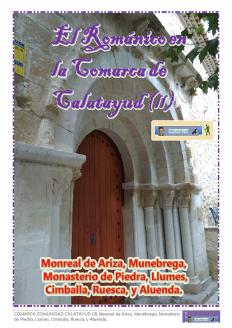
 En esta segunda parte complementa las localidades de esta comarca desde Monreal de Ariza, Munébrega, Monasterio de Piedra, Llumes, Cimballa, Ruesca, y Aluenda.
Encontraras las siguientes visitas:
- Monreal de Ariza.- Ha sido una villa de frontera con el reino de Castilla, podemos visitar las ruinas de lo que fue su Castillo. Iglesia de la Asunción. Templo original románico de finales del S. XII principios del XIII, con importante tamaño, fue ampliado y transformado en época barroca en el S. XVII. No es visitable. Iglesia Nueva de La Asunción. La visita se puede enriquecer con los Restos de la ciudad romana Arcóbriga sobre el cerro El Villar que se encuentra a unos2 km de la localidad.
- Monasterio de Piedra.- Ubicado en el término de Nuévalos, con un paraje natural excepcional, la visita incluye Los Jardines con infinidad de riachuelos que van surcando la orografía del terreno para precipitarse por cascadas y saltos en diferentes partes del parque o formación de grutas y se reúnen en el torrente de los Mirlos para formar y precipitarse en la famosa cascada de la Cola de Caballo. Iglesia Abacial, de estilo románico tardío del S. XIII, su planta de cruz latina típicamente cisterciense con tres naves de cinco tramos, la cabecera poligonal y cuatro ábsides de testero plano. Claustro. De planta rectangular en su panda norte se encuentra el acceso a la iglesia, en la este tenemos la sala Capitular, el Locutorio. En la ala sur el Refectorio, la Cocina, y lo que fue el antiguo Calefactorio. Y en la parte oeste con la Cilla, Bodega, etc. Palacio Abacial, de estilo barroco que se construyó en el S. XVII, y que hoy junto con las celdas son parte del complejo hotelero. Murallas y Torreón.
- Munébrega.- Localidad que en la parte alta de su caserío se encuentra la Iglesia de la Asunción, de sus inicios de una construcción mudéjar del S.XIV conserva su ábside, y en el tiempo ha ido pasando por diversas intervenciones y construcciones pasando por una iglesia barroca de planta de cruz griega del S, XVI, luego se rehízo en el S. XVIII. Posee un interesante Museo Parroquial
- Llumes.- Con el templo románico de la Iglesia de San Miguel, debió de construirse entre la segunda mitad del S. XII y principios del XIII con una sola nave de cuatro tramos con arcos fajones y cabecera semicircular con bóveda de horno. De su castillo solo queda una minúscula parte de un torreón.
- Cimballa.- Junto al río Piedra en un extremo de la comarca, es mencionada al estar incluida en el Fuero de Daroca en 1132 que otorgó Ramiro II de Aragón. Iglesia de La Presentación en el Templo. Este templo conserva la portada original del anterior románico perteneciente al S. XII finales o principios del XIII alojada bajo la torre de su campanario. El resto de la iglesia se construyó con piedra sillar, ladillo y tapial en el S. XVII-XVIII en estilo barroco y que ha tenido varias ampliaciones y reformas. Castillo. Queda un lienzo en sus ruinas de una construcción de los S. XV o XVI de planta cuadrada de una torre almenada.
- Ruesca.- Fue conquistada por Alfonso I El Batallador en 1182. Iglesia de Santo Domingo de Silos. Es una construcción mudéjar sobre el anterior templo románico, u posteriormente reformado en época barroca. Y los restos de su Castillo, es una torre de planta rectangular de unos 12m, es del S. XIV.
- Y Aluenda.- Asentado en la falda en la serranía de Vicor se desparrama su caserío, con la Iglesia de la Coronación de la Virgen y los restos de su puente romano de un ojo.
Puedes descargarte el PDF con información, planos, fotos y contactos.
Pulsar sobre la imagen con el botón derecho y guardar como…para descargar y llevar el archivo PDF en tu tablet o smartphone. Y si deseas conocer las nuevas publicaciones solo tienes incluirte en seguir.
-
CALATAYUD COMMUNITY REGION (II) Monreal de Ariza, Monasterio de Piedra, Llunes, Cimballa, Ruesca, and Aluenda.
In this second part, it complements the localities of this region from Monreal de Ariza, Munébrega, Monasterio de Piedra, Llumes, Cimballa, Ruesca, and Aluenda.
You will find the following visits:
- Monreal de Ariza.- It has been a border town with the kingdom of Castile, we can visit the ruins of what was its Castle. Church of the Assumption. Original Romanesque temple from the end of the 12th century to the beginning of the 13th century, with a significant size, it was enlarged and transformed in the Baroque period in the 17th century. It is not visitable. New Church of the Assumption. The visit can be enriched with the Remains of the Roman city Arcóbriga on the El Villar hill, which is located about 2 km from the town.
- Stone Monastery.- Located in the municipality of Nuévalos, with an exceptional natural setting, the visit includes The Gardens with an infinity of streams that cross the orography of the land to precipitate through waterfalls and jumps in different parts of the park or formation of caves. and they meet at the Mirlo stream to form and plunge into the famous Horse tail waterfall. Abbey Church, in the late Romanesque style of the 13th century, its Latin cross floor plan is typically Cistercian with three naves with five sections, a polygonal chancel and four flat front apses. Cloister. Rectangular in its north panda is the access to the church, in the east we have the chapter house, the parlor. In the south wing the Refectory, the Kitchen, and what was the old Heater. And in the western part with the Cilla, Bodega, etc. Abbey Palace, of baroque style that was built in the 17th century, and that today together with the cells are part of the hotel complex. Walls and Tower.
- Munébrega.- Town where the Church of the Assumption is located in the upper part of its hamlet. From its beginnings, it was a Mudejar construction from the 14th century and conserves its apse, and over time it has undergone various interventions and constructions, passing a baroque church with a Greek cross plan from the 16th century, later rebuilt in the 18th century. It has an interesting Parish Museum
- Llumes.- With the Romanesque temple of the Church of San Miguel, it must have been built between the second half of the 12th century and the beginning of the 13th century with a single nave with four sections with transverse arches and a semicircular chancel with an oven vault. Only a tiny part of a keep remains of his castle.
- Cimballa.- Next to the Piedra River at one end of the region, it is mentioned as being included in the Charter of Daroca in 1132 granted by Ramiro II of Aragon. Church of the Presentation in the Temple. This temple preserves the original cover of the previous Romanesque belonging to the late 12th century or early 13th century housed under its bell tower. The rest of the church was built with ashlar stone, brick and rammed earth in the 17th-18th centuries in a Baroque style and has undergone several extensions and reforms. Castle. There remains a canvas in its ruins of a construction from the 15th or 16th centuries with a square floor plan and a battlemented tower.
- Ruesca.- It was conquered by Alfonso I El Batallador in 1182. Church of Santo Domingo de Silos. It is a Mudejar construction on the previous Romanesque temple, or later reformed in the Baroque era. And the remains of its Castle, it is a rectangular tower of about 12m, it is from the 14th century.
- And Aluenda.- Settled on the slopes of the Vicor mountain range, its hamlet is spread out, with the Church of the Coronation of the Virgin and the remains of its one-eyed Roman bridge.
You can download the PDF with information, plans, photos and contacts.
Click on the image with the right button and save as… to download and take the PDF file on your tablet or smartphone. And if you want to know the new publications you just have to include yourself in following.
-
RÉGION COMMUNAUTAIRE DE CALATAYUD (II) Monreal de Ariza, Monasterio de Piedra, Llunes, Cimballa, Ruesca et Aluenda.
Dans cette deuxième partie, il complète les localités de cette région de Monreal de Ariza, Munébrega, Monasterio de Piedra, Llumes, Cimballa, Ruesca et Aluenda.
Vous trouverez les visites suivantes :
- Monreal de Ariza.- Elle a été une ville frontalière avec le royaume de Castille, nous pouvons visiter les ruines de ce qui était son château. Église de l’Assomption. Temple roman d’origine de la fin du XIIe siècle au début du XIIIe siècle, d’une taille importante, il fut agrandi et transformé à l’époque baroque au XVIIe siècle. Il n’est pas visitable. Nouvelle église de l’Assomption. La visite peut être enrichie par les vestiges de la ville romaine Arcóbriga sur la colline El Villar, située à environ 2 km de la ville.
- Monastère de Pierre.- Situé dans la municipalité de Nuévalos, avec un cadre naturel exceptionnel, la visite comprend Les Jardins avec une infinité de ruisseaux qui traversent l’orographie du terrain pour se précipiter à travers des cascades et des sauts dans différentes parties du parc ou de la formation de grottes et se rejoignent au ruisseau Mirlo pour se former et plonger dans la célèbre cascade Queue de cheval. Église abbatiale, de style roman tardif du XIIIe siècle, son plan en croix latine est typiquement cistercien avec trois nefs à cinq travées, un chœur polygonal et quatre absides à façade plate. Cloître. Rectangulaire dans son panda nord est l’accès à l’église, à l’est nous avons la salle capitulaire, le parloir. Dans l’aile sud le Réfectoire, la Cuisine, et ce qui était l’ancien Chauffeur. Et dans la partie ouest avec la Cilla, la Bodega, etc. Palais abbatial, de style baroque qui a été construit au XVIIe siècle et qui aujourd’hui, avec les cellules, fait partie du complexe hôtelier. Murs et tour.
- Munébrega.- Ville où se trouve l’Iglesia de la Asunción dans la partie supérieure de son hameau. Depuis ses débuts, c’était une construction mudéjare du XIVe siècle et conserve son abside, et au fil du temps, elle a subi diverses interventions et constructions, en passant devant une église baroque avec un plan en croix grecque du XVIe siècle, reconstruite plus tard au XVIIIe siècle. Il a un intéressant musée paroissial
- Llumes.- Avec le temple roman de l’église de San Miguel, il doit avoir été construit entre la seconde moitié du XIIe siècle et le début du XIIIe siècle avec une nef unique à quatre travées avec des arcs transversaux et un chœur en plein cintre avec une voûte de four. Il ne reste qu’une infime partie d’un donjon de son château.
- Cimballa.- À côté de la rivière Piedra à une extrémité de la région, il est mentionné comme étant inclus dans la Charte de Daroca en 1132 accordée par Ramiro II d’Aragon. Église de la Présentation au Temple. Ce temple conserve la couverture originale de l’art roman antérieur appartenant à la fin du XIIe siècle ou au début du XIIIe siècle logé sous son clocher. Le reste de l’église a été construit avec de la pierre de taille, de la brique et de la terre battue aux XVIIe et XVIIIe siècles dans un style baroque et a subi plusieurs extensions et réformes. Château. Il reste une toile dans ses ruines d’une construction des XVe ou XVIe siècles à plan carré et tour crénelée.
- Ruesca.- Conquise par Alfonso I El Batallador en 1182. Église de Santo Domingo de Silos. Il s’agit d’une construction mudéjare sur l’ancien temple roman, ou plus tard réformé à l’époque baroque. Et les vestiges de son Château, c’est une tour rectangulaire d’environ 12m, elle est du XIVe siècle.
- Et Aluenda.- Installé sur les pentes de la sierra du Vicor, son hameau s’étale, avec l’église du Couronnement de la Vierge et les restes de son pont romain borgne.
Vous pouvez télécharger le PDF avec informations, plans, photos et contacts.
Cliquez sur l’image avec le bouton droit et enregistrer sous… pour télécharger et emporter le fichier PDF sur votre tablette ou votre smartphone. Et si vous voulez connaître les nouvelles publications, il vous suffit de vous inclure dans la suite.
-
GEMEINSCHAFTSREGION CALATAYUD (II) Monreal de Ariza, Monasterio de Piedra, Llunes, Cimballa, Ruesca und Aluenda.
In diesem zweiten Teil ergänzt es die Ortschaften dieser Region von Monreal de Ariza, Munébrega, Monasterio de Piedra, Llumes, Cimballa, Ruesca und Aluenda.
Sie finden die folgenden Besuche:
- Monreal de Ariza.- Es war eine Grenzstadt mit dem Königreich Kastilien, wir können die Ruinen dessen besichtigen, was seine Burg war. Kirche Mariä Himmelfahrt. Ursprünglich romanischer Tempel vom Ende des 12. Jahrhunderts bis Anfang des 13. Jahrhunderts, mit einer bedeutenden Größe, wurde er in der Barockzeit im 17. Jahrhundert erweitert und umgestaltet. Es ist nicht besuchbar. Neue Kirche Mariä Himmelfahrt. Der Besuch kann mit den Überresten der römischen Stadt Arcóbriga auf dem Hügel El Villar bereichert werden, der sich etwa 2 km von der Stadt entfernt befindet.
- Kloster aus Stein.- In der Gemeinde Nuévalos gelegen, mit einer außergewöhnlichen natürlichen Umgebung, umfasst der Besuch die Gärten mit einer Unendlichkeit von Bächen, die die Orographie des Landes durchqueren, um durch Wasserfälle und Sprünge in verschiedenen Teilen des Parks oder der Formation zu stürzen von Höhlen und sie treffen sich am Mirlo-Bach, um den berühmten Wasserfall Pferdeschwanz zu bilden und in ihn zu stürzen. Abteikirche im spätromanischen Stil des 13. Jahrhunderts, ihr lateinischer Kreuzgrundriss ist typisch zisterziensisch mit drei Schiffen mit fünf Abschnitten, einem polygonalen Chor und vier flachen vorderen Apsiden. Kloster. Rechteckig im Norden ist Panda der Zugang zur Kirche, im Osten haben wir den Kapitelsaal, die Stube. Im Südflügel das Refektorium, die Küche und die alte Heizung. Und im westlichen Teil mit der Cilla, Bodega usw. Abteischloss im Barockstil, das im 17. Jahrhundert erbaut wurde und heute zusammen mit den Zellen Teil des Hotelkomplexes ist. Mauern und Turm.
- Munébrega.- Stadt, in der sich im oberen Teil ihres Weilers die Kirche Mariä Himmelfahrt befindet, die von Anfang an ein Mudéjar-Bau aus dem 14. Jahrhundert war und ihre Apsis bewahrt hat und im Laufe der Zeit verschiedene Eingriffe und Konstruktionen erfahren hat. vorbei an einer barocken Kirche mit griechischem Kreuzgrundriss aus dem 16. Jahrhundert, die später im 18. Jahrhundert umgebaut wurde. Es hat ein interessantes Pfarrmuseum
- Llumes.- Mit dem romanischen Tempel der Kirche von San Miguel muss sie zwischen der zweiten Hälfte des 12. Jahrhunderts und dem Beginn des 13. Jahrhunderts mit einem einzigen Schiff mit vier Abschnitten mit Querbögen und einem halbrunden Chor mit gebaut worden sein ein Ofengewölbe. Von seiner Burg ist nur noch ein winziger Teil eines Bergfrieds übrig.
- Cimballa.- Neben dem Piedra-Fluss an einem Ende der Region wird erwähnt, dass es in der Charta von Daroca im Jahr 1132 enthalten ist, die von Ramiro II von Aragon erteilt wurde. Kirche der Darstellung im Tempel. Dieser Tempel bewahrt die ursprüngliche Abdeckung der früheren Romanik aus dem späten 12. oder frühen 13. Jahrhundert, die unter seinem Glockenturm untergebracht ist. Der Rest der Kirche wurde im 17.-18. Jahrhundert im Barockstil aus Quadersteinen, Ziegeln und Stampflehm erbaut und mehrfach erweitert und umgestaltet. Schloss. In seinen Ruinen ist eine Leinwand eines Baus aus dem 15. oder 16. Jahrhundert mit quadratischem Grundriss und einem Zinnenturm erhalten.
- Ruesca.- Es wurde 1182 von Alfonso I. El Batallador erobert. Kirche Santo Domingo de Silos. Es ist ein Mudéjar-Bau auf dem früheren romanischen Tempel oder später in der Barockzeit reformiert. Und die Überreste seiner Burg, es ist ein rechteckiger Turm von etwa 12 m, er stammt aus dem 14. Jahrhundert.
- Und Aluenda.- An den Hängen des Vicor-Gebirges gelegen, erstreckt sich sein Weiler mit der Kirche der Krönung der Jungfrau Maria und den Überresten seiner einäugigen römischen Brücke.
Sie können das PDF mit Informationen, Plänen, Fotos und Kontakten herunterladen.
Klicken Sie mit der rechten Maustaste auf das Bild und speichern unter…, um die PDF-Datei herunterzuladen und auf Ihrem Tablet oder Smartphone zu übernehmen. Und wenn Sie die Neuerscheinungen wissen wollen, müssen Sie sich nur im Folgenden eintragen.
 Salidas